Bajaj Pulsar N125 Discontinued in India: What Happens to Buyers and Owners Now
Overview
Bajaj Pulsar N125 Discontinued in India: What Happens to Buyers and Owners Now brings key updates for two-wheeler buyers in India. Bajaj Pulsar N125 discontinued in India is now confirmed on ground, even though Bajaj hasn't put out an official press note about it. Multiple dealerships across the country have stopped
Bajaj Pulsar N125 discontinued in India is now confirmed on ground, even though Bajaj hasn't put out an official press note about it. Multiple dealerships across the country have stopped accepting fresh bookings, and dispatches from the factory dried up months ago. The bike's last known ex-showroom price sat between ₹91,690 and ₹93,160, which translated to an on-road figure of roughly ₹1.03 lakh to ₹1.14 lakh in cities like Delhi and Mumbai. For a motorcycle that arrived with real ambition less than two years ago, that's a quiet exit — and if you were tracking the N125 as a buy, or already own one, there's real ground to cover here.
So Is the Pulsar N125 Actually Gone From Showrooms?
Yes, practically speaking. The N125 is still technically visible on Bajaj's official website, which has led to some confusion online. But that listing doesn't mean much on the ground. Dealers we'd normally expect fresh stock from haven't received a new consignment in three to four months, and several have simply stopped taking bookings altogether. What's left is whatever unsold inventory individual showrooms are sitting on. Bajaj hasn't issued a formal discontinuation statement, which is fairly typical of how the company handles slow-selling models — it just lets supply dry up rather than announcing an exit.
What the N125 Actually Offered — Specs Worth Remembering
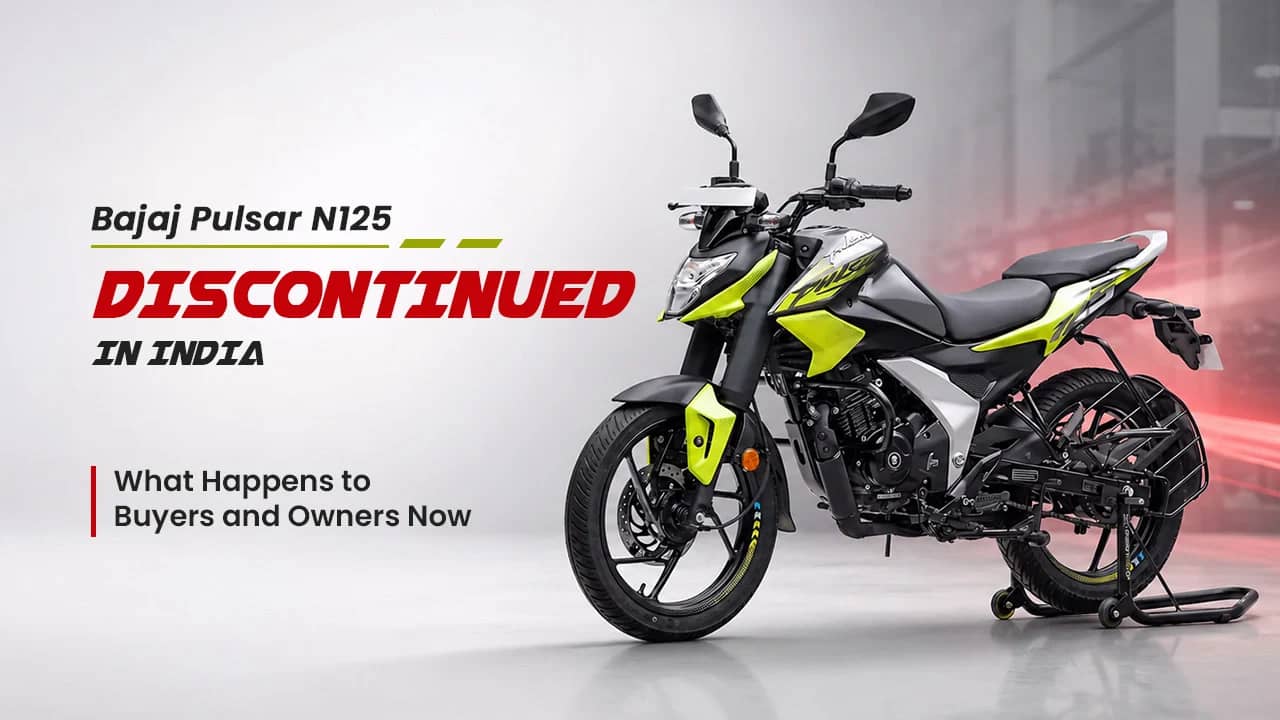
The Pulsar N125 wasn't a badge-engineered commuter with a new sticker job. Bajaj built it on a genuinely new platform, separate from the Pulsar 125 and Pulsar NS125 it sat alongside. Power came from a 124.59cc, air-cooled, fuel-injected single producing 12PS at 8,500rpm and 11Nm at 6,000rpm, run through a 5-speed gearbox. Kerb weight was pegged at just 125kg, among the lightest in its class, and Bajaj claimed a 0-60kph time of six seconds. Claimed mileage stood at 60kmpl, though real-world city running was closer to 50-55kmpl depending on how it was ridden. Seat height was a manageable 795mm. On paper, none of that reads like a bike destined to fail.
Why Did Bajaj Pull the Plug?
Nothing here is officially confirmed, so treat these as informed reasoning rather than Bajaj's own words. The most obvious issue was internal overlap — the N125 was fighting for the same buyer as the existing Pulsar 125 and Pulsar NS125, both of which already have loyal followings and established resale value. Traditional Pulsar buyers also tend to want a chunkier, more muscular stance, and the N125's slim, stretched-out styling didn't land the way Bajaj hoped. It also skipped features that rivals were already offering as standard, including a TFT console and ABS, which hurt it against a segment that's grown genuinely feature-conscious. Weak demand, not a mechanical flaw, is what killed this bike.
If You Already Own One: Should You Worry?
Not really, and this is the part most articles on this topic skip entirely. Discontinuation of a model doesn't mean Bajaj stops supporting it — the N125 shares its engine architecture loosely with other Pulsar 125cc siblings that remain in production, so spare parts availability through Bajaj's service network should stay reasonably healthy for years. Warranty terms on bikes already sold don't change either; your standard coverage period runs its course regardless of what happens to new production. Resale value is the one area to watch — discontinued models sometimes see softer resale simply because buyers assume support will vanish, even when it doesn't. If you're planning to sell in the next year, expect slightly tougher negotiation, not a collapse in value.
Buy Leftover Stock, or Look Elsewhere?
If a dealer is still holding N125 units and willing to discount meaningfully off that ₹93,160 ex-showroom figure, it's worth a look — you're essentially buying a well-engineered bike at a clearance price. But if there's no real discount on the table, the smarter move is to consider what else the segment offers right now.
| Bike | Approx. On-Road Price (Delhi) | Claimed Mileage |
| Bajaj Pulsar N125 (last stock) | ₹1.03–1.14 lakh | 60kmpl |
| TVS Raider 125 | ₹1.05–1.15 lakh | 65kmpl |
| Honda SP 125 | ₹1.02–1.10 lakh | 65kmpl |
| Hero Xtreme 125R | ₹1.10–1.20 lakh | 55kmpl |
The Raider 125 brings a longer feature list at a similar price point, while the SP 125 leans on Honda's reputation for reliability and lower long-term running costs. The Xtreme 125R competes closest on styling and character but costs a bit more on-road. Bajaj's own Pulsar NS125 remains a sensible in-house alternative if you don't want to walk away from the brand.
The Real Numbers: Fuel Cost and EMI
Running the N125 for a typical 1,500km monthly commute, at a real-world 55kmpl and petrol priced around ₹103/litre, works out to roughly ₹2,800 a month in fuel. A rival like the Honda SP 125, returning closer to 60kmpl in real conditions, would bring that down to around ₹2,575 — a modest but real difference over a year of ownership. On the finance side, assuming a ₹15,000 down payment against the ₹1.05 lakh on-road price and a loan of roughly ₹90,000 at 11% interest over 24 months, expect an EMI in the ₹4,200-4,500 range. These are estimated figures based on typical Bajaj Finance terms and will shift depending on your credit profile and the dealer's actual financing partner.
The verdict is straightforward: the N125 was a genuinely interesting motorcycle let down by positioning, not engineering, and buying leftover stock only makes sense if the discount is substantial. Otherwise, the Raider 125, SP 125 or Bajaj's own NS125 are the more sensible calls right now. Check the on-road price and EMI for the Bajaj Pulsar N125 and its rivals in your city on Drivio.
Bajaj Pulsar N125 discontinued in India is now confirmed on ground, even though Bajaj hasn't put out an official press note about it. Multiple dealerships across the country have stopped accepting fresh bookings, and dispatches from the factory dried up months ago. The bike's last known ex-showroom price sat between ₹91,690 and ₹93,160, which translated to an on-road figure of roughly ₹1.03 lakh to ₹1.14 lakh in cities like Delhi and Mumbai.