Overview
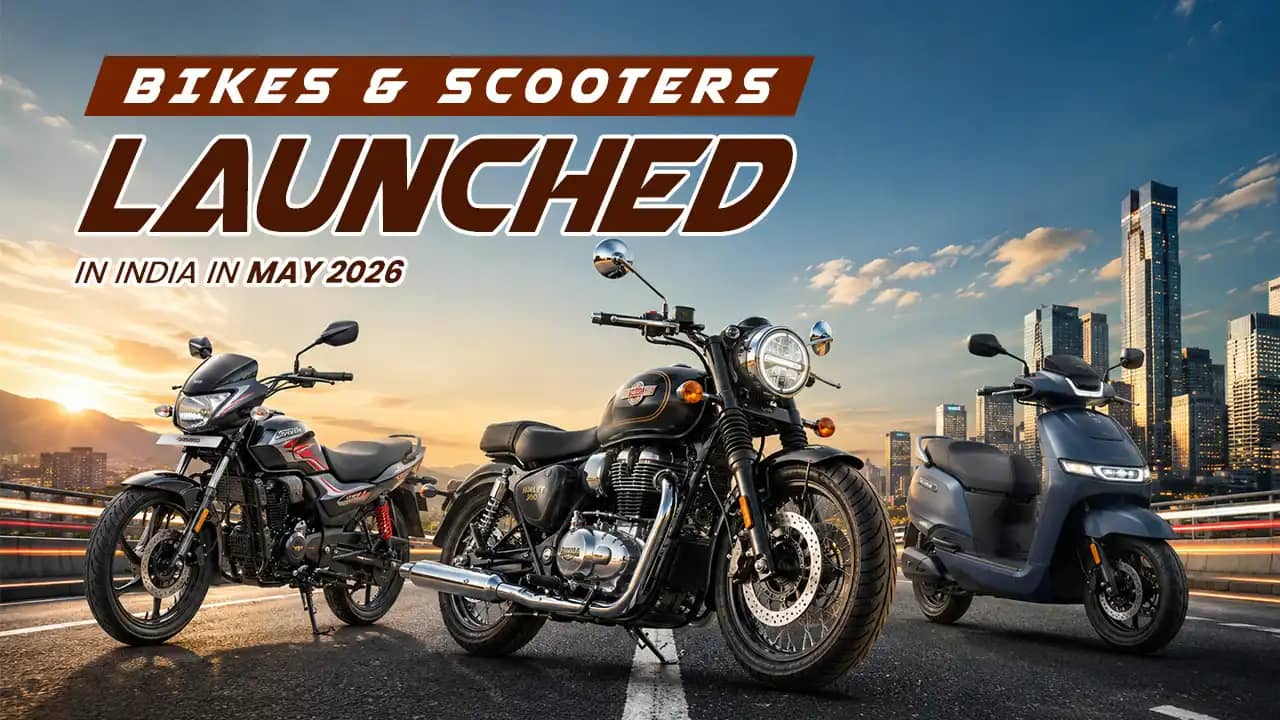
Bikes and Scooters Launched in India in May 2026 brings key updates for two-wheeler buyers in India. Bikes and Scooters Launched in India in May 2026 covered a range that few months manage — from an ₹86,500 commuter to a ₹3.65 lakh retro icon, with an EV
Bikes and Scooters Launched in India in May 2026 covered a range that few months manage — from an ₹86,500 commuter to a ₹3.65 lakh retro icon, with an EV upgrade and an impending premium adventure launch threading through it all. Four confirmed launches define this month, with the Royal Enfield Bullet 650 taking the headline, and a fifth big arrival — the Norton Atlas — knocking hard on June's door. Whether you're shopping for your first motorcycle or upgrading from something you've ridden for five years, May 2026 gave India's two-wheeler buyers something worth looking at across nearly every segment.
New Bikes Launched in India This May
Royal Enfield Bullet 650 — The Most Emotional Launch of the Year
₹3,64,865 ex-showroom (Chennai)
Royal Enfield launched the Bullet 650 on 28 May 2026, and the significance goes well beyond the spec sheet. The Bullet name has been on Indian roads since 1932. Bringing it to the 648cc parallel-twin platform — the same engine that powers the Interceptor 650, Super Meteor 650, Shotgun 650 and Classic 650 — isn't a product decision, it's a statement about where Royal Enfield sees its most beloved nameplate going next.
The engine itself needs little introduction: a 647.95cc, air and oil-cooled parallel-twin producing 46.4 bhp and 52.3 Nm, paired with a six-speed gearbox with slip-and-assist clutch. Suspension is handled by Showa telescopic forks at the front (120mm travel) and twin rear shock absorbers offering 90mm of travel. Braking hardware includes dual-channel ABS as standard — the one rider safety item that was non-negotiable at this price.
Design-wise, Royal Enfield has kept the Bullet's identity completely intact. Round headlight with tiger-eye DRLs, teardrop fuel tank with hand-painted pinstripes and 3D metal badging, a more squared-off rear fender compared to the Classic 650 Twin, and a single-piece stepped seat that's friendlier to pillions than the Classic's arrangement. Available in two colours: Cannon Black and Battleship Blue.
At ₹3.65 lakh, the Bullet 650 slots in at the same price as the base Classic 650 Twin and is ₹14,000 less expensive than the Chrome variant — which makes it the most accessible entry into Royal Enfield's 650cc twin portfolio.
What this means for Indian riders: The 243 kg kerb weight is an honest number — this is not a city slipper. Anyone doing daily commutes in Bengaluru or Delhi traffic will find it demanding at low speeds. But for the rider who does Rajasthan in January and Spiti in September and wants a motorcycle that carries emotional weight alongside gear bags, the Bullet 650 is a genuine upgrade from the 350 without requiring the identity shift that the Interceptor demands. The parallel-twin's low-end torque suits Indian highways far better than the 350's single-cylinder thump, and the refinement gap is immediately noticeable.
Vs the Classic 650: The choice between the Bullet 650 and Classic 650 comes down entirely to riding preference. Same platform, same engine, similar price — the Bullet gets a more traditional single-piece seat, a different design language, and arguably a stronger emotional pull. Classic 650 buyers skew urban-retro; Bullet 650 buyers want something rawer.
Verdict: Worth every rupee if you ride beyond city limits regularly. This may also be the last motorcycle Royal Enfield builds on the 650cc platform — the 750cc engine is reportedly entering validation. Buy the Bullet 650 with that context in mind.
Hero Super Splendor XTEC 2.0 — The Commuter That Earns Its Keep
₹86,500 (drum) / ₹90,000 (disc) ex-showroom, Delhi
Hero MotoCorp launched the Super Splendor XTEC 2.0 on 27 May, and this is a motorcycle that doesn't chase attention — it just quietly does what the 125cc segment in India has always demanded: reliability, mileage, and enough modernity to justify the upgrade over the previous version.
The powerplant is the familiar 124.7cc single-cylinder producing 10.7 bhp at 7,500 rpm and 10.6 Nm at 6,000 rpm, fed through Advanced Programmed Fuel Injection (APFI) and supported by Hero's i3S idle stop-start system. The claimed efficiency figure is 72 kmpl — up 4 kmpl from the standard XTEC variant — which is genuinely best-in-class for 125cc commuters and directly meaningful to buyers who track fuel spend carefully.
The headline feature for 2026 is the segment-first hazard light system — something that should have arrived in this segment years ago. Add a USB Type-C charging port, a kill switch, silent starter integrated with the i3S system, Bluetooth connectivity, a fully digital console, and refreshed dual-tone graphics in five colour options, and the XTEC 2.0 is a meaningful upgrade over its predecessor.
Suspension remains conventional telescopic forks up front and twin rear shock absorbers — no surprises there, nor should there be at this price. Drum brakes on the base variant, disc at the front on the ₹90,000 version.
What this means for Indian riders: The Super Splendor XTEC 2.0's target buyer is clear — a daily office commuter, a family's secondary vehicle, or a small-town rider who needs something economical, dependable, and modern enough to feel relevant in 2026. The 72 kmpl efficiency figure becomes significant at current petrol prices, and the hazard lights will matter on Indian roads more than most spec-sheet items do.
Vs the competition: Against the Honda Shine 125, TVS Raider 125, and Bajaj Pulsar 125, the Super Splendor XTEC 2.0's segment-first hazard lights and the Bluetooth connectivity give it a differentiation edge. The TVS Raider 125 remains the sportier choice for younger buyers, but the Super Splendor XTEC 2.0 wins on the combination of fuel efficiency, features, and Hero's unmatched service network depth across Tier 2 and Tier 3 India.
Is the upgrade worth it from the standard XTEC? At just ₹2,052 more than the outgoing XTEC drum variant, the XTEC 2.0 brings enough to justify the difference. The decision is straightforward.
New Scooters Launched in India This May
TVS iQube S (2026) — More Range, More Relevant
₹1,59,142 ex-showroom, Delhi
TVS launched the updated iQube S on 6 May 2026 with a larger battery pack, higher range, and two new colour options. This isn't a new model — it's a meaningful mid-cycle upgrade to India's best-selling electric two-wheeler range, and the timing reflects TVS's understanding of where the EV commuter segment is heading.
The biggest change is under the panels: the iQube S now carries a 4.7 kWh battery pack powering a 4.4 kW peak motor. Claimed range has risen to 175 km (IDC), top speed is rated at 82 km/h, and the 0–40 km/h sprint is achieved in 4.3 seconds — all claimed figures. The riding experience is supported by TVS's connected features suite, TFT instrument display with Bluetooth, reverse assist, and riding mode selection.
New colour options are Magnificence Purple Beige and Harlequin Blue Beige, both distinctly premium-feeling finishes that reinforce the family scooter positioning. Mercury Grey Gloss carries over from before.
The price increase of ₹19,500 over the previous iQube S is the main talking point. TVS is asking buyers to pay more for more range and a larger battery — the value calculation depends on daily riding patterns.
What this means for Indian riders: For urban commuters covering 50–80 km daily across cities like Pune, Hyderabad or Chennai, 175 km of claimed range effectively means every-other-day charging or more. That's the range anxiety solution the iQube S needed. Fast-charging support makes top-ups practical during lunch breaks or short office stops.
Vs the Ather Rizta and Bajaj Chetak: The iQube S sits in a competitive three-way battle. Ather Rizta has the build quality premium but carries a higher price. Bajaj Chetak C35 recently got updates but the TVS's wider service network remains its strongest card. For a buyer in a city where TVS dealer coverage is strong, the iQube S is the default sensible choice. For buyers who prioritise ride dynamics and premium hardware, the Ather still wins.
Is the ₹19,500 premium justified? If your daily riding regularly exceeds 100 km or if range anxiety is a genuine concern, yes. If you're averaging 40–50 km a day in the city, the base iQube 3.5 kWh at ₹1,35,043 remains the smarter spend.
What May 2026 Reveals About India's Two-Wheeler Market
Several patterns are visible from this month's launches that extend beyond the individual products.
The Royal Enfield Bullet 650's arrival confirms that the premium retro segment in India is no longer a niche — it's now a volume consideration. Royal Enfield has methodically built its 650cc portfolio across seven motorcycles, and each launch has expanded the customer base rather than cannibalised existing buyers. The Bullet name, specifically, pulls in a different buyer than the Interceptor or Super Meteor, which is the point: one platform, multiple identities, broad market reach.
The TVS iQube S update and Yamaha's continued rollout of the EC-06 (launched in February 2026 at ₹1.67 lakh and continuing to expand city availability through May) tell a consistent EV story: the market is maturing beyond early adopter buyers. The iQube range is already India's highest-selling electric two-wheeler, with retail sales of 37,193 units recorded in April 2026 alone — these are mainstream numbers. The conversation is no longer whether EVs belong in urban India; it's about which EV earns the sale.
The Hero Super Splendor XTEC 2.0's launch is a reminder that the mass commuter segment — 100cc to 125cc — remains the volume backbone of Indian two-wheelers and that it is slowly but deliberately absorbing features previously reserved for premium motorcycles. Segment-first hazard lights might seem like a minor addition; on Indian roads, it could prevent accidents. That's the kind of feature adoption that matters at scale.
Premium adventure motorcycle demand is also unmistakable. The Norton Atlas, built at TVS's Hosur plant and expected at around ₹5–7 lakh with a 585cc parallel-twin engine, has been spotted in final testing and is effectively a June or July event. The pipeline for mid-displacement ADVs in India has never been stronger — BMW F 450 GS has already arrived, the Royal Enfield Himalayan 750 is in testing, and the Norton Atlas is weeks away.
One broader shift worth noting: manufacturer confidence in pricing has risen noticeably. When Royal Enfield can launch a 650cc retro twin at ₹3.65 lakh and position it as competitively priced, it signals how far India's premium two-wheeler buyer has evolved. Five years ago, that price would have required justification. Today, it barely needs an explanation.
Which Launch Stands Out Most?
The Royal Enfield Bullet 650 is the most significant launch from May 2026 — not because of its specification, but because of what it represents.
It brings the 648cc parallel-twin platform to the most emotionally resonant nameplate in Indian motorcycling at the most competitive price in the 650cc lineup. It gives Bullet 350 owners a logical upgrade path that doesn't ask them to abandon their identity. It arrives as arguably the final product on Royal Enfield's 650cc platform, which adds a considered-purchase quality to it that other launches simply don't carry.
At ₹3.65 lakh ex-showroom, with 46.4 bhp, 52.3 Nm, a six-speed gearbox, dual-channel ABS, and a design that is unmistakably Bullet, this motorcycle offers an objective case for itself without needing brand loyalty to carry the argument. It is good value, genuinely. The Classic 650 and Interceptor 650 established the 650cc twin as a credible proposition in India — the Bullet 650 makes it accessible to the largest single slice of the Royal Enfield customer base.
For anyone on the fence between the 350 and the twin-cylinder world: this is your entry point.
Check the on-road price and EMI options for your preferred bike or scooter on Drivio.
Bikes and Scooters Launched in India in May 2026 covered a range that few months manage — from an ₹86,500 commuter to a ₹3.65 lakh retro icon, with an EV upgrade and an impending premium adventure launch threading through it all. Four confirmed launches define this month, with the Royal Enfield Bullet 650 taking the headline, and a fifth big arrival — the Norton Atlas — knocking hard on June's door.