Overview
Updated Bajaj Pulsar N160 Spied Testing Ahead of August Launch brings key updates for two-wheeler buyers in India. A camouflaged Bajaj Pulsar N160 test mule has been caught testing on public roads again
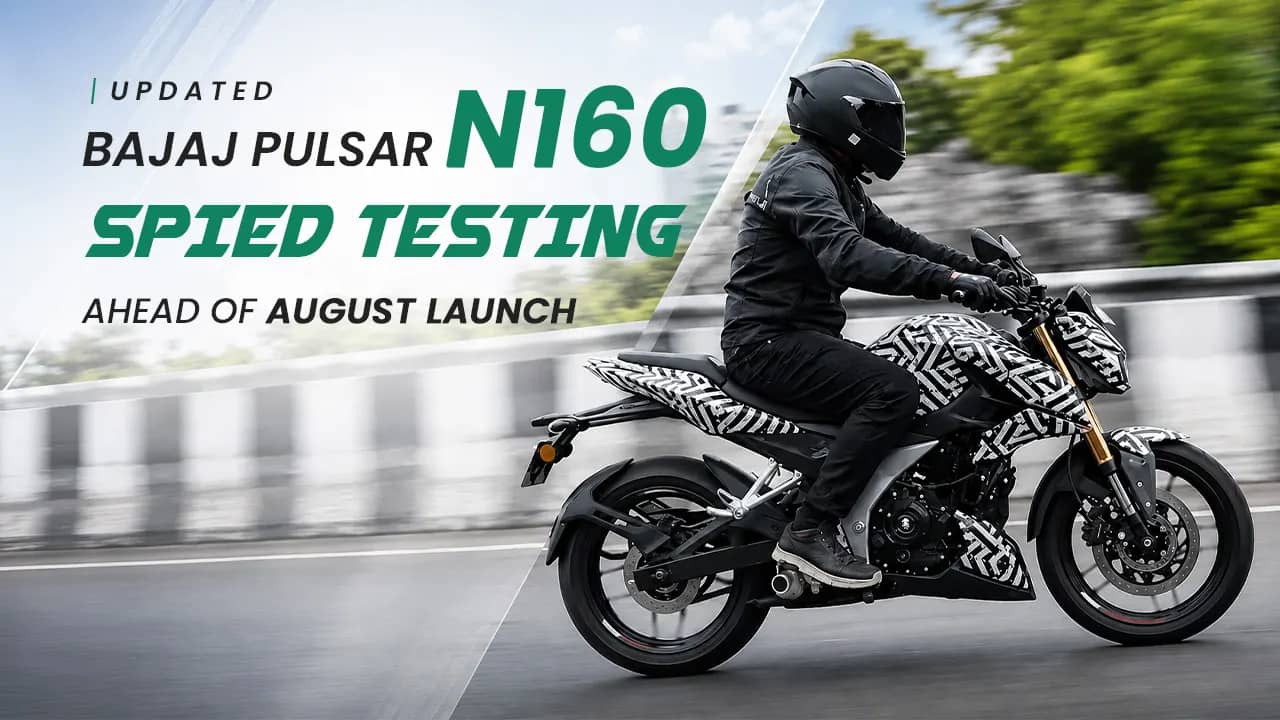
A camouflaged Bajaj Pulsar N160 test mule has been caught testing on public roads again, and this time the timing gives the game away. Bajaj has already sent out invites for a first ride event on August 12, and a full commercial launch is expected within days of that. The current Pulsar N160 range, updated with gold USD forks earlier this year, starts at ₹1,23,983 ex-showroom Delhi for the Dual Channel Single Seat USD variant. This new test mule, spotted with a split seat and full body camouflage, suggests Bajaj isn't done tweaking India's most affordable USD-fork streetfighter just yet.
What's Different on This Pulsar N160 Test Mule
The bike photographed this week carries a split-seat setup, which points to the range-topping Dual Channel Split Seat USD trim rather than an all-new variant. Zoom into the images and there's not much to see on the surface — same headlight cowl borrowed from the Pulsar N250, same tank shrouds, same tail section. That's not unusual for a bike that only got a fork and electronics update a few months ago. What's interesting is what's hidden under the camouflage wrap: engine covers. Bajaj typically doesn't bother masking mechanical bits unless something inside has changed.
Multiple reports now point to a 4-valve head replacing the current 2-valve unit on the 164.82cc air-cooled single. As it stands, the Pulsar N160 makes 16 PS at 8,750rpm and 14.65Nm at 6,750rpm — figures that have barely moved since the bike launched in 2022. A 4-valve conversion, similar to what TVS and Hero already run on their 160cc rivals, would let Bajaj claw back some of the top-end breathing the current two-valve motor lacks. Expect a modest bump, not a dramatic one — think 17-18PS rather than anything closer to the 250cc Pulsars.
Why This Matters for Buyers Waiting to Book
If you've been holding off on a Pulsar N160 booking because you'd heard whispers of an update, this is your answer: wait a few more weeks. Bajaj rarely spies test mules this close to a launch without reason, and an invite already sitting in dealer inboxes for August 12 all but confirms the timeline. Anyone who books the current-spec bike now risks buying into last month's engine days before a genuine spec bump lands.
Price, Variants and What's Confirmed So Far
The existing lineup runs from ₹1,23,983 for the base USD single-seat variant up to roughly ₹1.36-1.38 lakh for the split-seat, dual-channel ABS flagship, both ex-showroom Delhi. On-road pricing in Delhi typically adds 10-12% for insurance and RTO charges, pushing the top variant closer to ₹1.52-1.55 lakh. Should the 4-valve head make it to production, don't expect Bajaj to hold pricing flat — a realistic bump of ₹4,000-8,000 across the range would still keep the N160 competitively priced against its main rival, the TVS Apache RTR 160 4V.
Feature-wise, the current N160 already punches above its price bracket. It gets a colour LCD console with Bluetooth via Bajaj's Ride Connect app, turn-by-turn navigation, ABS ride modes (Road, Rain, Off-road), and an assist-and-slipper clutch. If the spy shots hold up, expect these to carry over unchanged, with the engine tweak being the sole mechanical story.
Bajaj Pulsar N160 vs TVS Apache RTR 160 4V
| Spec | Bajaj Pulsar N160 (current) | TVS Apache RTR 160 4V |
| Engine | 164.82cc, air-cooled, 2-valve | 159.7cc, oil-cooled, 4-valve |
| Power | 16PS @ 8,750rpm | 17.55PS @ 8,000rpm |
| Torque | 14.65Nm @ 6,750rpm | 14.73Nm @ 6,500rpm |
| Ex-showroom price (Delhi) | ₹1.24-1.38 lakh | ₹1.28-1.45 lakh |
The Apache has held a small power advantage since the N160 launched, largely because it's run a 4-valve head from the start. A 4-valve Pulsar N160 closes that gap and lets Bajaj compete on more even footing without touching the price advantage it currently holds over the TVS.
Running Costs: EMI, Fuel and Service
Assuming the updated N160 lands close to its current on-road Delhi price of around ₹1.40 lakh, a typical Drivio finance structure — 20% down payment, 60-month tenure, 11% interest — works out to roughly ₹28,000 upfront and an EMI near ₹2,435 per month. Over the full loan term, that adds up to about ₹1.46 lakh in repayments, meaning total interest paid comes to roughly ₹34,000 across five years.
Real-world fuel efficiency on the current N160 sits around 42-46kmpl in mixed city and highway riding, a figure the 4-valve update likely won't change much given the modest power gain expected. At today's Delhi petrol price of ₹103/litre, a rider covering 1,200km a month would spend approximately ₹2,700-2,750 on fuel — roughly ₹90 a day for someone commuting daily. Scheduled maintenance up to 10,000km, covering two to three service visits, typically runs between ₹4,000 and ₹4,500 at authorised Bajaj Service centres, including oil changes and routine part replacements.
Should You Wait for the Updated Pulsar N160?
If a 4-valve engine genuinely makes production, it addresses the one real complaint owners have had with the N160 since 2022: a motor that feels slightly breathless past 7,500rpm compared to the Apache. Everything else about the bike — the USD forks, the ride modes, the navigation-enabled console — already works well and doesn't need fixing. Buyers who ride mostly in traffic, where torque matters more than top-end power, won't notice much difference either way. Buyers who value outright performance and open-road overtaking should hold off until August 12, when Bajaj is expected to confirm whether this test mule's engine cover was hiding something real or just routine testing gear.
Either way, this is shaping up to be one of the more meaningful updates to the N-series since its debut. Check the on-road price and EMI for the Bajaj Pulsar N160 in your city on Drivio.
A camouflaged Bajaj Pulsar N160 test mule has been caught testing on public roads again, and this time the timing gives the game away. Bajaj has already sent out invites for a first ride event on August 12, and a full commercial launch is expected within days of that. The current Pulsar N160 range, updated with gold USD forks earlier this year, starts at ₹1,23,983 ex-showroom Delhi for the Dual Channel Single Seat USD variant.