New Delhi


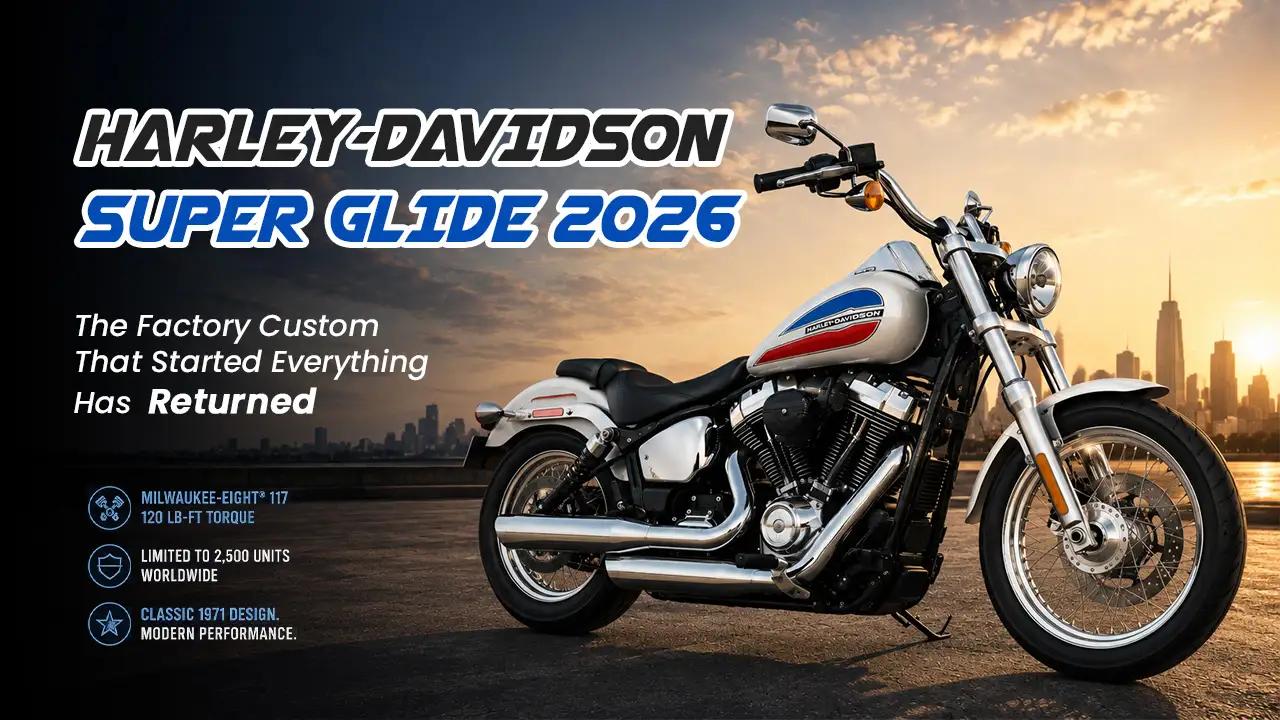

Harley-Davidson Super Glide 2026: The Factory Custom That Started Everything Has Returned
News by Drivio | 12 Jun 2026
The Harley-Davidson Super Glide 2026 is official — announced on June 11, 2026, the Milwaukee manufacturer has revived one of the most consequential names in American motorcycle history as a limited-edition Special Edition model. Production is capped at just 2,500 serialized units, and availability is restricted to the United States and Canada. The motorcycle is priced at USD 15,999 (approximately Rs. 13.4 lakh at current exchange rates), placing it firmly in the premium cruiser bracket.
The timing is tied to the 250th anniversary of the United States, and Harley-Davidson has made no attempt to downplay the patriotic framing. But look past the anniversary branding and what you have is a motorcycle that revisits one of the brand's most defining design decisions — the factory custom format first introduced in 1971 — and rebuilds it on an entirely modern platform. This is not a restoration project. It is a ground-up cruiser with contemporary hardware dressed in period-accurate livery, and for riders who understand what the Super Glide name actually represents, that distinction matters considerably.
Why the Super Glide Name Matters
In 1971, Harley-Davidson did something unusual. Willie G. Davidson — who had joined the Motor Company as a designer in 1963 and had been studying the custom bike culture emerging from Los Angeles streets — took a Big Twin FL chassis and paired it with the narrow front fork from the XL Sportster. The result was the FX Super Glide: the first complete motorcycle to emerge from Harley's own designers carrying what enthusiasts had been doing in garages for years. It defined the factory custom as a category.
The original Super Glide wore a white finish with red and blue striping and a stretched Bar and Shield tank graphic — colour combinations that Harley's own ad copy described as a nod to American flag imagery. The motorcycle was polarising in 1971. Its boat-tail rear fender (soon dropped) drew mixed reactions. But the underlying idea — a lean, purposeful Harley built around the rider rather than the touring rider — proved enormously influential. The Super Glide lineage ran from that 1971 FX model through the Dyna era and ended its last official chapter in 2013 as the Super Glide Custom.
The name returning in 2026 after a 13-year absence, and 55 years after the original's debut, is not a casual branding exercise. For Harley loyalists who know this history, the Super Glide label carries real weight — it was the motorcycle that told the industry what factory customs could look like.
Design Inspired by the Original Super Glide
Harley-Davidson has been deliberate about what it carried forward from 1971 and what it updated for 2026, and the balance shows. The 2026 Super Glide wears White Onyx Pearl paint with red and blue fender striping and the same stretched Bar and Shield tank graphic that Willie G. drew for the original. The five-gallon teardrop fuel tank with its chrome console is lifted directly from the original's visual vocabulary, as are the tubeless laced wheels with bright aluminium hubs and chrome cast-aluminium rims.
The chrome specification is extensive. Powertrain covers, the air cleaner cover, exhaust, side covers, rear fender struts, signals, and headlamp are all finished in brilliant chrome. The handlebar is a chrome mini ape, placing the rider in what Harley calls a 'fists in the wind' posture — a riding stance the original Super Glide popularised. Front and rear fenders echo the proportions of the 1971 model without reproducing its more dated elements.
The overall silhouette is low and stripped-down. There are no bags, no fairing, no windscreen, and no visual clutter. The motorcycle is intended to look exactly like what a knowledgeable Harley owner would have wanted their factory bike to look like in 1971, built with 2026 manufacturing standards. The serialization plaque on the fuel tank console is the only visible acknowledgement that this is a limited-edition unit, not a production-spec model.
Engine, Chassis and Modern Hardware
The 2026 Super Glide is powered by the Milwaukee-Eight 117 Classic V-Twin — the most accessible of Harley's current 117ci engines. 'Classic' in this context refers to a specific tuning approach: the engine is calibrated for a broad, flat torque curve rather than peak output, with 120 lb-ft (163 Nm) arriving at just 2,500 rpm. Peak power is rated at 98 hp (73 kW). For a cruiser intended to reward low-speed riding and open-road pulling, this power delivery is well-matched to the application.
The platform is Harley's Softail chassis — which makes the 2026 Super Glide the first single-shock Super Glide in the name's history. Earlier generations used a Dyna frame with twin rear shocks. The Softail hides its monoshock beneath the seat, preserving the visual impression of a hardtail while providing a functioning rear suspension. Rear suspension travel is 3.4 inches, with under-seat hydraulic pre-load adjustment for load management. The front end uses 49mm dual-bending valve forks.
Braking is handled by a 300mm single front disc and a 292mm single rear disc. Both ends carry Dunlop Harley-Davidson Series tires: a 100/90B19 at the front, 150/80B16 at the rear.
The modern hardware package is more substantial than the retro exterior suggests. Standard equipment includes:
• Straight-line and Cornering ABS (C-ABS)
• Straight-line and Cornering Traction Control (C-TCS)
• Drag Torque Slip Control (DSCS and C-DSCS)
• Tire Pressure Monitoring System (TPMS)
• Three rider modes: Road, Sport, and Rain
• Full LED lighting
• Console-mounted instrument cluster — analogue speedometer with multifunction LCD display
• USB-C charging port
The safety electronics are a meaningful step beyond anything the original Super Glide's era could have imagined — and their presence should matter to buyers who plan to actually ride the motorcycle, not simply display it.
2026 Harley-Davidson Super Glide — Key Specifications
| Engine | Milwaukee-Eight 117 Classic V-Twin |
| Displacement | 117 cu in (1,923 cc) |
| Bore x Stroke | 4.075" x 4.50" |
| Peak Torque | 120 lb-ft (163 Nm) @ 2,500 rpm |
| Peak Power | 98 hp (73 kW) |
| Compression Ratio | 10.3:1 |
| Frame | Softail (single rear monoshock) |
| Front Forks | 49 mm dual-bending valve |
| Rear Suspension | Monoshock, 3.4 inches travel |
| Front Brake | Single disc, 300 mm rotor |
| Rear Brake | Single disc, 292 mm rotor |
| Front Tyre | 100/90B19 Dunlop H-D Series |
| Rear Tyre | 150/80B16 Dunlop H-D Series |
| Fuel Tank | 5 gallons (18.9 litres) |
| MSRP (US) | USD 15,999 |
| Production | 2,500 serialized units (US & Canada only) |
Where It Fits in the 2026 Harley-Davidson Lineup
The Super Glide sits within Harley's cruiser portfolio alongside models like the Fat Boy, Street Bob, Low Rider S, and Nightster. It shares the Softail platform with the Fat Boy and Heritage Classic, but its target is a different type of buyer — one who values stripped-down minimalism over touring comfort or blacked-out aggression.
The Fat Boy leans on visual mass and muscle. The Low Rider S is calibrated for performance, with a more aggressive tune and riding position. The Street Bob occupies a broadly similar minimalist-cruiser space, but the Super Glide brings a specific historical identity that the Street Bob does not carry. Among the 2026 Harley lineup, it is the only model that explicitly references a specific motorcycle from the company's past, serialises every unit, and limits availability as a matter of design policy rather than supply constraint.
Harley-Davidson is positioning the Super Glide at collectors and experienced riders who want a modern, fully functional cruiser but also want to own something with a documented place in the brand's lineage. Compared with the Liberty Edition models — which celebrate the same 250th anniversary with special paint on production-spec bikes — the Super Glide is the more considered tribute: it changes the motorcycle itself, not just the colour.
Harley-Davidson Super Glide vs Modern Cruiser Rivals
The Super Glide's most direct competitors in global markets are the Indian Chief, the Triumph Bonneville Bobber, and Harley's own Low Rider S. Each represents a different interpretation of what a large-capacity cruiser should be in 2026.
| Feature | H-D Super Glide 2026 | Indian Chief | Triumph Bonneville Bobber |
| Engine | M-Eight 117, 1,923cc | Thunderstroke 116, 1,890cc | HT1200, 1,200cc |
| Peak Torque | 120 lb-ft @ 2,500 rpm | 126 lb-ft | ~77 lb-ft |
| Platform | Softail, monoshock | Steel tube frame, dual shocks | Parallel twin, monoshock |
| Electronics | C-ABS, C-TCS, 3 ride modes | ABS, TC, ride modes | ABS, TC, ride modes |
| Production | 2,500 units (limited) | Full production | Full production |
| US Price (approx.) | USD 15,999 | USD 17,999+ | USD 13,995 |
| Heritage factor | FX lineage since 1971 | Chief lineage since 1921 | Bonneville lineage since 1959 |
Against the Indian Chief, the Super Glide has the narrower visual profile and the more accessible price point, but the Indian carries more torque and a slightly longer lineage claim. The Triumph Bonneville Bobber appeals to riders who prefer a European approach to cruiser refinement — its parallel-twin engine and more precise chassis make it a different kind of motorcycle rather than a direct competitor in the traditional V-twin sense. The Low Rider S remains the choice for riders who want Harley's heritage association but want to push the machine harder: it is tuned more aggressively and sits lower, closer to the sport-cruiser bracket.
The Growing Retro Motorcycle Trend — and What It Means for Indian Buyers
The Super Glide's revival does not happen in isolation. Globally, heritage-styled motorcycles have been among the most consistent growth segments in the premium two-wheeler market through the early 2020s. The Royal Enfield Meteor, Honda CB350, and Jawa models demonstrated that Indian riders are willing to pay for motorcycles that project a sense of historical identity, and that interest has scaled upward into premium segments. Triumph's updated Bonneville Bobber and Speedmaster have both seen strong India reception; Indian Motorcycle has quietly expanded its dealer network here; and Harley-Davidson itself re-entered the Indian market with a restructured strategy following its 2020 partnership with Hero MotoCorp.
The global appetite for rider-focused, visually uncluttered cruisers — machines that reference a specific era without being museum pieces — continues to grow. Manufacturers from Royal Enfield to Honda to BMW have responded with heritage-inflected design across multiple displacement segments. The Super Glide's revival fits this commercial logic, even if Harley's execution is framed around an American national anniversary rather than an explicit market strategy.
For Indian Harley enthusiasts specifically: the 2026 Super Glide is not confirmed for India. Harley-Davidson has announced the motorcycle as exclusive to the US and Canada market, with no indication of an India allocation. This is not surprising given the limited production run of 2,500 units worldwide — there simply may not be enough supply to distribute internationally. The last Super Glide model sold in India, the Super Glide Custom, was discontinued in 2013 and was last priced at approximately Rs. 12.17 lakh at the time of discontinuation. Were a comparable model to reach India in 2026, import duties and local taxes would place it significantly above its US MSRP — likely in the Rs. 28–35 lakh bracket on-road, depending on configuration and applicable duties. But without an official India allocation, pricing speculation remains academic for now.
Harley-Davidson India's current cruiser range runs from the Sportster S (Rs. 14.54 lakh) and Street Bob (Rs. 18.05 lakh) up through the Fat Boy (Rs. 25.71 lakh) and Low Rider S (Rs. 20.23 lakh). Indian enthusiasts who want the closest production-available equivalent to the Super Glide's stripped-down spirit would find the Street Bob the most obvious point of comparison within the current India lineup.
Verdict
The 2026 Harley-Davidson Super Glide is a well-executed limited-edition that does what it sets out to do. It revisits a motorcycle with genuine significance in cruiser history, uses the correct visual language from the original, and builds it on a platform — the Softail with Milwaukee-Eight 117 — that offers real-world performance rather than nostalgia-compromised hardware. The electronics package is comprehensive. The riding position is authentic. The production cap of 2,500 units makes it inherently collectible.
The question serious buyers should weigh is whether the Super Glide adds something the Street Bob or Fat Boy does not. The answer is primarily about provenance and specificity. If you want the particular lineage of the 1971 FX — the serialized connection to the motorcycle that defined factory customs as a category — the 2026 Super Glide is the only way to access it through a new purchase. If that history does not move you, the Fat Boy or Street Bob will deliver a broadly similar riding experience without the limitations on colour choices, availability, or the collectibility premium that may eventually arrive with these 2,500 units.
For the Harley owner who knows what Willie G. Davidson built in 1971 and wants a modern version of that specific idea, the Super Glide 2026 is the most direct answer Harley-Davidson has offered in over a decade. That is not a small thing.
Check the latest Harley-Davidson prices, on-road costs, and finance options on Drivio.