Bajaj Freedom 125 vs TVS iQube: CNG vs Electric Running Cost at 50,000 km — Which One Actually Saves You Money?
Overview
Bajaj Freedom 125 vs TVS iQube: CNG vs Electric Running Cost at 50,000 km — Which One Actually Saves You Money? brings key updates for two-wheeler buyers in India. The Bajaj Freedom 125 — India's first CNG motorcycle — launched at ₹95
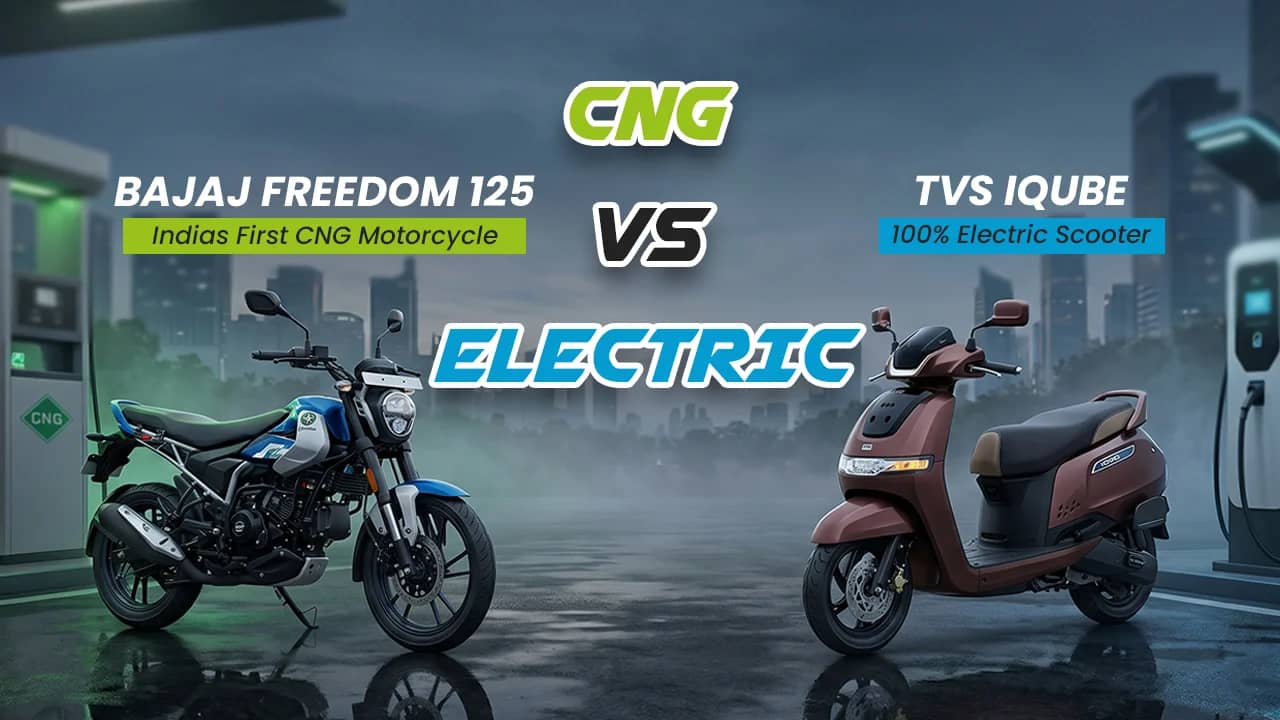
The Bajaj Freedom 125 — India's first CNG motorcycle — launched at ₹95,000 ex-showroom and made every urban commuter do a double-take at the fuel pump. Set against the TVS iQube S, priced at ₹1,13,434 ex-showroom in Delhi, this isn't just a technology debate. It's a straight financial question: which machine costs less to run across 50,000 kilometres of Indian roads? Run the numbers honestly, and the answer will surprise you.
Why Running Cost Beats Sticker Price Every Time
For someone commuting 40–50 km daily in Gurugram, Pune, or Bengaluru, the purchase price is the smallest part of what you'll actually spend. The real money accumulates in fuel, servicing, and unplanned repairs across three to four years of daily riding. Both the Freedom 125 and the iQube exist precisely to reduce that burden — but they do it through completely different bets on India's energy infrastructure, and only one of them delivers predictable, low-risk savings.
The Bajaj Freedom 125: What CNG Actually Costs in Practice
The Freedom 125 runs a 125cc single-cylinder engine producing 9.6 PS and 9.7 Nm, mated to a 5-speed gearbox — making it a proper motorcycle, not a scooter, despite how it's often categorised. It carries a 2 kg CNG tank plus a 2-litre petrol reserve for when the green fuel isn't available. Bajaj's claimed efficiency of 102 km/kg on CNG is optimistic; real-world riding in mixed urban conditions delivers closer to 72–78 km/kg, with 75 km/kg being the realistic benchmark.
CNG in Delhi currently costs approximately ₹76 per kg. At 75 km/kg, you're spending ₹1.01 per kilometre on CNG. Over 50,000 km, the fuel bill alone is roughly ₹50,500. Add servicing — standard Bajaj intervals plus a biennial CNG pressure test at around ₹700 — and maintenance over 50,000 km runs ₹18,000–22,000. Total running cost over the distance: approximately ₹70,000–72,000.
TVS iQube: The Electric Numbers, Honestly
The TVS iQube S carries a 4.56 kWh lithium-ion battery and a 4.4 kW hub motor, with TVS claiming around 100 km per charge in Eco mode. On Normal mode across India's stop-start urban traffic — which is where most owners actually ride — expect 78–85 km per charge as a reliable real-world figure. Charging at home on a standard 5A socket costs approximately ₹7.5 per unit, filling the pack for about ₹34 per full charge. At 80 km real-world range, that's ₹0.43 per kilometre — less than half the Freedom 125's CNG cost per km.
Over 50,000 km, electricity costs around ₹21,500. Maintenance is genuinely minimal — no engine oil, no air filters, negligible brake pad wear thanks to regenerative braking — costing roughly ₹8,000–10,000 over the distance. Total iQube running cost: approximately ₹30,000–32,000.
That gap — ₹40,000 cheaper to run — looks like a decisive win for electric. But there's a catch buried in the warranty document.
CNG vs Electric: The 50,000 km Total Cost of Ownership
TVS warrants the iQube battery for 3 years or 50,000 km, whichever comes first. If you're a 45-km-a-day commuter, you'll hit 50,000 km in roughly three years — right at the warranty boundary. Battery replacement, should degradation force one, is likely to cost ₹35,000–50,000. That single expense flips the entire equation: the iQube's total ownership cost (purchase plus running plus a battery swap) climbs to ₹1,79,000–1,94,000, compared to the Freedom 125's ₹1,66,000 all-in.
Infrastructure: The Variable Neither Brand Advertises Honestly
The Freedom 125's CNG dependency is a real geographical risk. In Delhi, Mumbai, Pune, and Ahmedabad, CNG stations are frequent enough to make the bike genuinely practical. Venture into tier-2 cities or highway travel, and the 2-litre petrol reserve — good for roughly 110 km at real-world efficiency — becomes less of a backup and more of a primary fuel. The network is expanding in May 2026, but it's still metro-centric.
The iQube's constraint is different in nature. Public fast-charging for two-wheelers has improved meaningfully in India's larger cities, but apartment dwellers without dedicated parking — a majority of urban renters — still find overnight charging unreliable. The 5-hour charge time on a 5A socket is perfectly workable if you have a guaranteed plug point; it's a genuine inconvenience if you don't.
We've followed both the Ather 450X and the Ola S1 Pro closely on Drivio, and battery degradation anxiety remains the single most common concern from readers who've crossed the 30,000 km mark on either platform. The Freedom 125 has no equivalent worry — CNG engines are mechanically simple, and Bajaj's service network across India is one of the most established in the business.
Which One Actually Wins for Indian Commuters
The TVS iQube S wins on running cost — there's no disputing that ₹0.43 per km beats ₹1.01 per km. But the Freedom 125 wins on total cost predictability and infrastructure reliability, particularly outside the six largest metros. For a daily rider in Delhi or Mumbai with guaranteed home charging, the iQube makes strong sense over three years — assuming the battery holds. For everyone else, especially riders in cities where CNG infrastructure is solid but EV charging remains inconsistent, the Bajaj Freedom 125 is the lower-risk financial decision over 50,000 km.
The on-road price for the Freedom 125 in Delhi works out to approximately ₹1,06,000, while the iQube S lands at roughly ₹1,26,000 — a ₹20,000 gap at the point of purchase that the iQube's lower running costs recover within 18 months, provided no battery issues arise. That's a meaningful qualifier. Before you decide which side of that bet suits your riding life, check the exact on-road price and monthly EMI for the Bajaj Freedom 125 or TVS iQube S in your city on Drivio.
The Bajaj Freedom 125 — India's first CNG motorcycle — launched at ₹95,000 ex-showroom and made every urban commuter do a double-take at the fuel pump. Set against the TVS iQube S, priced at ₹1,13,434 ex-showroom in Delhi, this isn't just a technology debate.