New Delhi



Bajaj Pulsar NS400Z vs KTM 390 Duke 2026 — Is the Extra ₹1.3 Lakh Worth It?
Reviews by Drivio | 20 May 2026
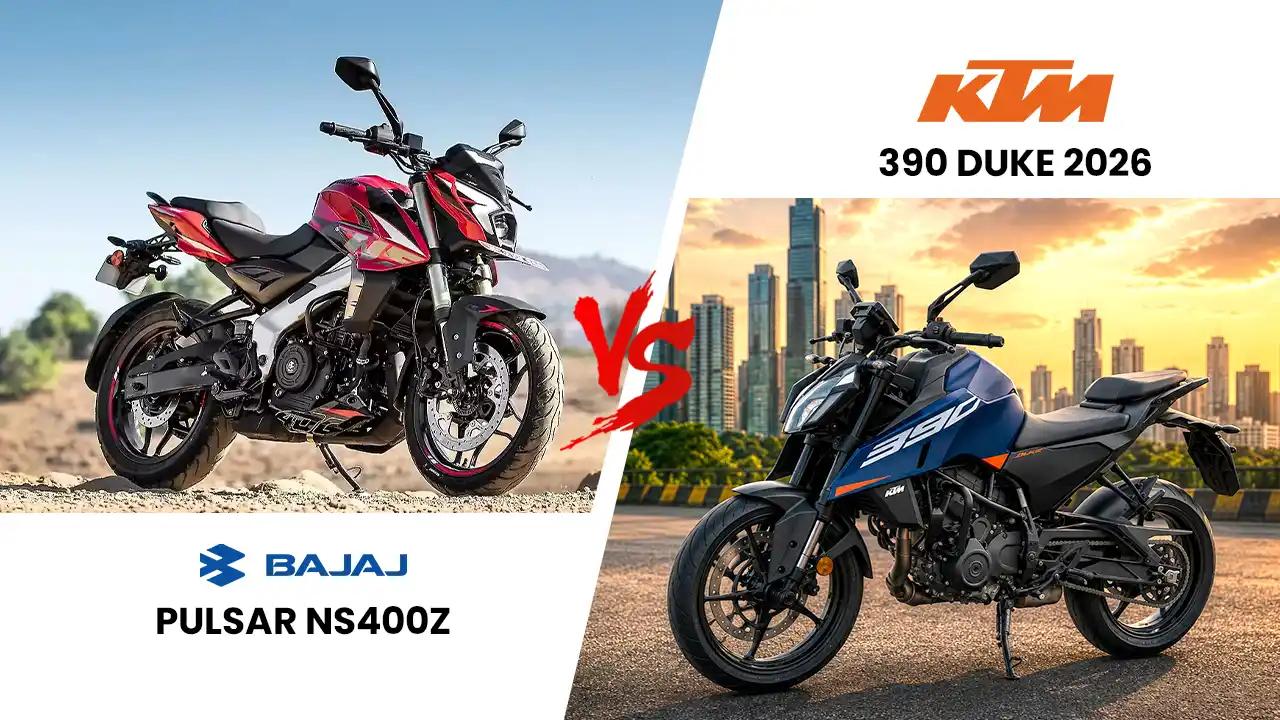
The Bajaj Pulsar NS400Z vs KTM 390 Duke 2026 rivalry is the sharpest value debate in India's 400cc naked bike segment today. At ₹1.85 lakh ex-showroom Delhi, the NS400Z and the ₹3.15 lakh KTM 390 Duke 2026 are not in the same price bracket — but they absolutely are in the same buyer's shortlist. Both are liquid-cooled, single-cylinder streetfighters with USD forks, dual-channel ABS, and the kind of performance that makes weekend rides genuinely rewarding. The question isn't which is faster. It's whether the Duke's ₹1.3 lakh premium translates into ₹1.3 lakh worth of real-world difference for an Indian rider.
What the Spec Sheets Actually Tell You
Bajaj's NS400Z is powered by a 373.3cc liquid-cooled, DOHC single-cylinder engine producing 40 PS at 8,500 rpm and 37 Nm of peak torque at 6,500 rpm. The KTM 390 Duke 2026 runs a larger 399cc liquid-cooled DOHC single, pushing out 46 PS at 9,000 rpm and 39 Nm at 7,000 rpm. That's a 6 PS and 2 Nm advantage for the Duke — meaningful at the top end, but not transformative in the real-world conditions most Indian riders encounter daily.
Both machines share a strong hardware baseline: USD front forks, a slipper clutch, dual-channel ABS, and LED lighting are standard on each. The Duke 2026 then pulls ahead with cornering ABS, a full-colour TFT display with Bluetooth connectivity, ride-by-wire throttle, and multiple riding modes including a supermoto setting. The NS400Z offers a more conventional LCD instrument cluster and a single riding mode — capable but noticeably less sophisticated.
Where the Duke's additional technology justifies itself is on spirited rides where you're actually using the electronics. On a B-road twisties run, cornering ABS and the sharper throttle response of ride-by-wire genuinely change the riding experience. On a Monday morning commute through Gurugram or Andheri, those features are invisible.
Specs Comparison at a Glance
| Specification | Bajaj Pulsar NS400Z | KTM 390 Duke 2026 |
| Engine | 373.3cc, LC, DOHC Single | 399cc, LC, DOHC Single |
| Max Power | 40 PS @ 8,500 rpm | 46 PS @ 9,000 rpm |
| Peak Torque | 37 Nm @ 6,500 rpm | 39 Nm @ 7,000 rpm |
| Top Speed | ~160 kmph | ~172 kmph |
| Real-World Mileage | 30–32 kmpl | 28–30 kmpl |
| Ex-Showroom Delhi | ₹1.85 lakh | ₹3.15 lakh |
How Each Bike Performs on Indian Roads
The KTM 390 Duke has earned its reputation on Indian roads over several generations, and the 2026 model sharpens that formula further. The engine is noticeably peakier — it rewards high revs and feels most alive above 6,500 rpm, where the power delivery builds into a proper rush toward the 9,000 rpm redline. The chassis is precise, quick to change direction, and gives strong feedback through corners. For riders who seek that level of engagement on weekend runs, the Duke delivers in a way that is genuinely difficult to match at this price point.
The NS400Z takes a different approach. Its torque curve is broader and more accessible, with the bulk of its grunt available well below 6,000 rpm. In traffic-heavy conditions — whether it's peak-hour congestion on Delhi's Ring Road or Mumbai's Western Express Highway — that tractable power delivery is a daily comfort. The suspension, while using quality USD hardware, is tuned slightly softer than the Duke's, which helps absorb the broken surfaces and sudden potholes that define real Indian riding conditions outside metro expressways.
The Mileage Reality at ₹103 Per Litre
With petrol sitting at approximately ₹103 per litre across most Indian cities in May 2026, real-world fuel efficiency has a direct impact on monthly running costs. The NS400Z returns 30–32 kmpl in mixed riding conditions; the Duke manages 28–30 kmpl. Over a monthly riding distance of 2,000 km, that works out to a saving of roughly ₹500–700 in favour of the Bajaj — not life-changing on its own, but it compounds over the ownership period.
The Price Gap Is Bigger Than It Looks on a Showroom Sticker
This is where the Bajaj Pulsar NS400Z vs KTM 390 Duke 2026 comparison becomes most consequential. The NS400Z's on-road price in Delhi comes to approximately ₹2.10–2.20 lakh, factoring in registration, insurance, and road tax. The KTM 390 Duke 2026's on-road price in Delhi is approximately ₹3.55–3.65 lakh — and in Mumbai, expect to add another ₹10,000–15,000 on top of that due to higher road tax.
Financed over 36 months at standard lending rates, the Duke's premium translates to roughly ₹4,000–4,500 extra per month on your EMI compared to the NS400Z. Over three years, that's close to ₹1.6 lakh in additional outflow — enough to cover two years of servicing, quality riding gear, and several weekend trips without blinking.
For a first-time performance bike buyer stepping up from a 150cc or 200cc commuter, this isn't an abstract number. It fundamentally shapes what the rest of your riding life looks like — whether you can afford the gear, the trips, and the occasional track day, or whether the EMI itself becomes the dominant relationship you have with the bike.
Where the KTM Still Justifies Its Premium
The Duke 2026 isn't just faster — it's a more complete motorcycle on every measurable dimension. The TFT display with navigation is something you use on every single ride, not just the spirited ones. The cornering ABS and supermoto mode give experienced riders tools the NS400Z simply doesn't offer. KTM's overall build quality and the sharper, more communicative chassis remain class-defining in India's 400cc segment.
There's also a practical service consideration that often goes unmentioned: in major metros — Delhi, Mumbai, Bengaluru, Hyderabad, Pune — KTM's dealer network is dense enough that ownership is straightforward. Outside these cities, Bajaj's far wider service reach becomes a real advantage for the NS400Z, particularly for long-distance touring riders.
We've previously covered the KTM 390 Duke ownership costs on Drivio and the Bajaj Pulsar NS400Z EMI calculator for your city — both worth bookmarking before you visit a showroom.
Bajaj Pulsar NS400Z vs KTM 390 Duke 2026: The Honest Verdict
The Duke 2026 is the better motorcycle. That's not a difficult call — better engine, sharper chassis, smarter electronics, and a more premium overall experience. But the NS400Z is the better buy for the majority of Indian riders in 2026. It delivers around 85% of the Duke's real-world performance, matches it on core hardware, and costs ₹1.3 lakh less at purchase — a gap that only widens when you factor in on-road pricing, fuel costs, and service expenses over time.
If you're a first-time performance bike buyer, budget-conscious, or based outside a major metro — the NS400Z is not a compromise. It's a genuinely strong machine at a price that leaves room to actually enjoy owning it. If you've ridden performance bikes before, want the full electronics suite, and the Duke's premium fits comfortably within your finances — buy the Duke without hesitation.
Before you finalise either decision, check the exact on-road price and monthly EMI for the NS400Z or 390 Duke in your city on Drivio — the city-to-city variance can be as much as ₹15,000–18,000, and that number matters before you sign anything.