Royal Enfield Meteor 350 vs Honda CB 350 vs TVS Ronin: Which One Wins in 2026?
Overview
Royal Enfield Meteor 350 vs Honda CB 350 vs TVS Ronin: Which One Wins in 2026? reveals upcoming Honda two-wheeler developments, detailing new platform designs, key technological features, and expected market debuts tailored for Indian motorcycle and scooter enthusiasts.
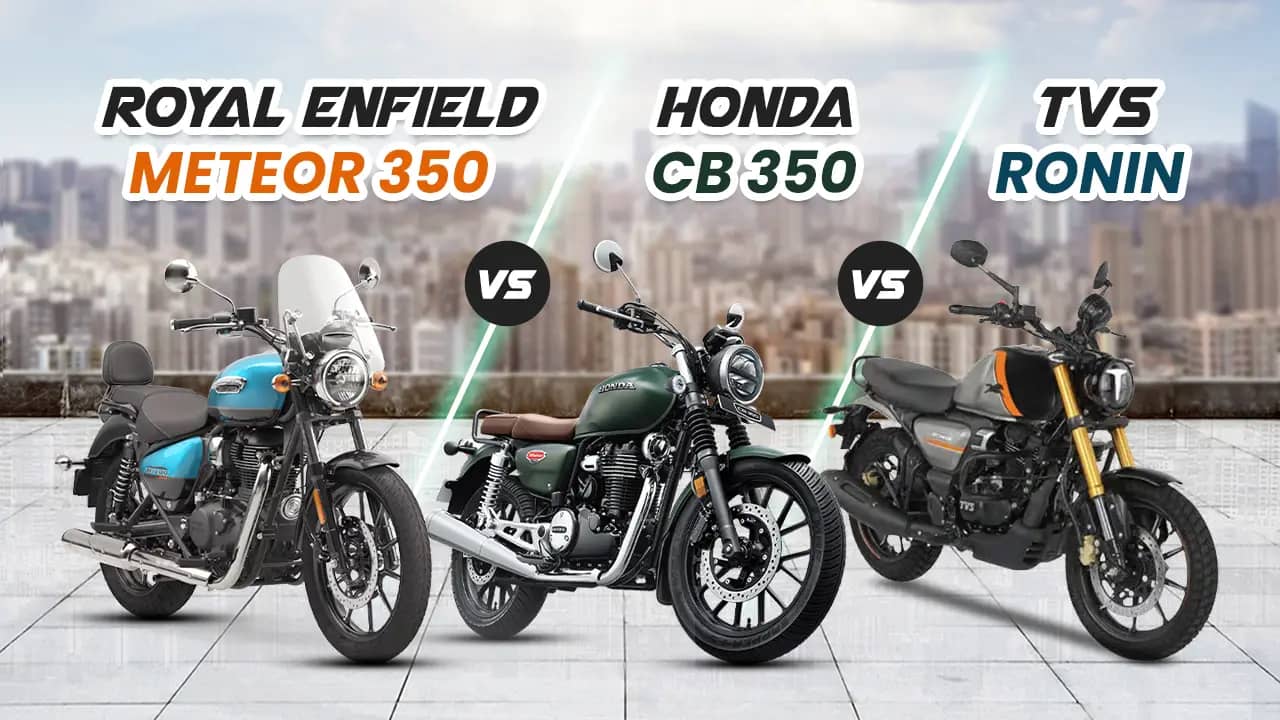
The Royal Enfield Meteor 350 vs Honda CB 350 vs TVS Ronin is one of the most loaded three-way comparisons in India's ₹1.5–2.2 lakh motorcycle market right now — three machines with sharply different personalities, all fighting for the same buyer's weekend-ride budget. As of May 2026 in India, the Meteor 350 starts at ₹1.99 lakh ex-showroom Delhi, the H'Ness CB 350 opens at ₹1.92 lakh, and the TVS Ronin undercuts both at ₹1.49 lakh. That gap tells part of the story. The rest of it is considerably more nuanced.
What Kind of Motorcycle Are You Actually Buying?
Before you go spec-hunting, understand that these three bikes are not built for the same rider — even if they're parked next to each other in the segment. The Meteor 350 is a proper cruiser, unhurried and plush, engineered around a low 765 mm seat height and relaxed forward footpegs. The Honda H'Ness CB 350 is a neo-retro roadster with an upright, confidence-inspiring posture — think Classic 350 rival with Japanese refinement baked in. The TVS Ronin, meanwhile, is best described as a scrambler-inspired all-rounder, leaning into style and urban agility with a lightweight 159 kg kerb weight that makes both rival 350s feel portly by comparison.
Royal Enfield's Meteor weighs in at 191 kg, Honda's H'Ness at 181 kg. That difference isn't just on paper — it shows up in U-turns on narrow Delhi lanes, in slow-moving Bengaluru traffic, and when you're hauling the bike onto a stand after a five-hour highway run.
Engine and Real-World Performance
Here's where the Royal Enfield Meteor 350 vs Honda CB 350 vs TVS Ronin fight gets far more interesting than a simple displacement comparison suggests.
The Meteor 350's 349.34cc, air/oil-cooled single-cylinder produces 20.2 bhp at 6,100 rpm and 27 Nm at 4,000 rpm. On the road, it feels most at home between 70–90 kmph and rarely seems stressed. The 2025 refresh brought a factory-fit slip-and-assist clutch, making city traffic considerably more bearable, though the engine still runs noticeably warm in crawling stop-go conditions — a trait Meteor riders know well. The top speed hovers around 114 kmph, which is honest cruiser territory.
Honda's 348.36cc motor is arguably the most refined engine of the three. It produces 21.07 PS at 5,500 rpm and a class-leading 30 Nm at just 3,000 rpm — that low-rev torque figure is what makes the H'Ness feel so effortlessly punchy in city traffic. Honda's Selectable Torque Control (HSTC), which is essentially traction control at this price point, is a genuine differentiator. Owners report a consistent real-world mileage of 33–37 kmpl, and the top speed reportedly touches 140 kmph with room to spare.
The TVS Ronin runs a 225.9cc, oil-cooled engine — immediately marking it as the odd one out in a 350cc conversation. It makes 20.4 PS at 7,750 rpm but only 19.93 Nm at 3,750 rpm. The Ronin demands you rev it harder to extract its performance, which isn't everyone's idea of a relaxed tourer. What it does offer on higher trims are USD (upside-down) front forks — hardware you simply won't find on either 350cc rival at any price.
Specs Comparison: Royal Enfield Meteor 350 vs Honda CB 350 vs TVS Ronin
| Specification | RE Meteor 350 | Honda H'Ness CB 350 | TVS Ronin |
| Engine | 349.34cc, air/oil-cooled | 348.36cc, air-cooled | 225.9cc, oil-cooled |
| Max Power | 20.2 bhp @ 6,100 rpm | 21.07 PS @ 5,500 rpm | 20.4 PS @ 7,750 rpm |
| Peak Torque | 27 Nm @ 4,000 rpm | 30 Nm @ 3,000 rpm | 19.93 Nm @ 3,750 rpm |
| Top Speed (est.) | ~114 kmph | ~140 kmph | ~120 kmph |
| Real-World Mileage | 30–34 kmpl | 33–37 kmpl | 36–40 kmpl |
| Ex-Showroom Delhi | ₹1.99–2.23 lakh | ₹1.92–1.97 lakh | ₹1.49–1.72 lakh |
Features and Technology That Actually Matter
The H'Ness CB 350's feature list is genuinely hard to argue with at this price. Bluetooth connectivity, dual-channel ABS, HSTC traction control, an assist and slipper clutch, and a semi-digital instrument console — Honda has loaded real premium technology into a bike that undercuts the Meteor 350 on sticker price. The one catch: it's sold exclusively through Honda BigWing outlets, which limits reach in Tier 2 and Tier 3 cities where Royal Enfield's dealer network runs deep.
The Meteor 350, post its 2025 update, now comes with the Tripper navigation pod standard across all variants — a turn-by-turn GPS that integrates with Google Maps and is genuinely useful when you're navigating unfamiliar highway junctions at night. Adjustable levers and a standard slipper clutch round out what is now a more complete package than the bike was at launch. The on-road price in Delhi for the base Fireball variant works out to approximately ₹2.27 lakh, and it climbs to ₹2.53 lakh for the top Sundowner Orange edition.
The TVS Ronin counters with a TFT instrument cluster featuring Bluetooth pairing, multiple ride modes, and a USB charging port — arguably the most feature-dense display in the segment. Its base variants get single-channel ABS, with dual-channel stepping in higher up the range. The on-road price in Delhi starts around ₹1.70 lakh and tops out near ₹2.00 lakh — making its technology value per rupee exceptionally compelling.
How These Bikes Actually Feel on Indian Roads
The Meteor 350 is the machine you want on a 400 km weekend run from Delhi to Jaipur. Long-travel suspension, a wide cushioned saddle, and a motor that's perfectly content sitting at 80–85 kmph for hours on end make distance feel effortless. Real-world mileage lands around 30–34 kmpl — at ₹103/litre for petrol, expect a monthly fuel cost of roughly ₹2,800–3,200 for a 50 km/day riding pattern. Drivio has previously covered the Royal Enfield Hunter 350 extensively, and the Meteor occupies a distinctly more touring-focused, comfort-first position than its sibling.
The Honda H'Ness CB 350 edges out to 33–37 kmpl in real-world riding. Its upright ergonomics feel more versatile — as comfortable in stop-and-go traffic as on a Sunday morning highway run. The 30 Nm torque peak arriving at just 3,000 rpm means you rarely need to drop below third gear in city traffic, which is a notable comfort advantage on congested Indian roads. If you've looked at the CB350RS that Drivio has covered, the H'Ness is the more classically styled, pillion-friendly expression of the same outstanding powertrain.
The Ronin, at 36–40 kmpl, is the most fuel-efficient bike in this comparison — logical given its 225cc displacement. Monthly fuel spend for 50 km/day riding drops to around ₹2,400–2,700 at current Delhi petrol prices. However, its need to be revved harder on the highway, especially above 90 kmph, introduces vibrations that the two 350cc bikes simply don't produce. For urban commuters covering 20–40 km daily, the Ronin makes a genuinely strong case. For riders who put in weekend touring kilometres regularly, it's a trade-off.
Which One Should You Actually Buy?
The Royal Enfield Meteor 350 vs Honda CB 350 vs TVS Ronin verdict comes down cleanly to how you plan to use the bike. Highway tourers and long-distance riders should shortlist the Meteor 350 — its cruiser ergonomics, Tripper navigation, and Royal Enfield's unmatched service network across India make it the most complete mile-muncher here. Urban riders who want the segment's most refined engine with traction control and Bluetooth at a slightly lower starting price should look hard at the H'Ness CB 350 — Honda's 30 Nm torque motor and featherlight clutch action make daily riding genuinely effortless. And if budget is a real constraint or you want a lightweight, tech-forward urban commuter with a distinctive scrambler aesthetic, the TVS Ronin makes a compelling pitch at nearly ₹50,000 less than its rivals.
Before you commit, check the exact on-road price, current bank offers, and month-wise EMI for the Meteor 350, H'Ness CB 350, or TVS Ronin in your city on Drivio — insurance costs and RTO charges vary enough between Mumbai, Delhi, and Pune to meaningfully change the on-road equation.
The Royal Enfield Meteor 350 vs Honda CB 350 vs TVS Ronin is one of the most loaded three-way comparisons in India's ₹1.5–2.2 lakh motorcycle market right now — three machines with sharply different personalities, all fighting for the same buyer's weekend-ride budget.