Hero Xpulse 200 vs Royal Enfield Meteor 350: Adventure Or Cruiser For Weekend Riders
Overview
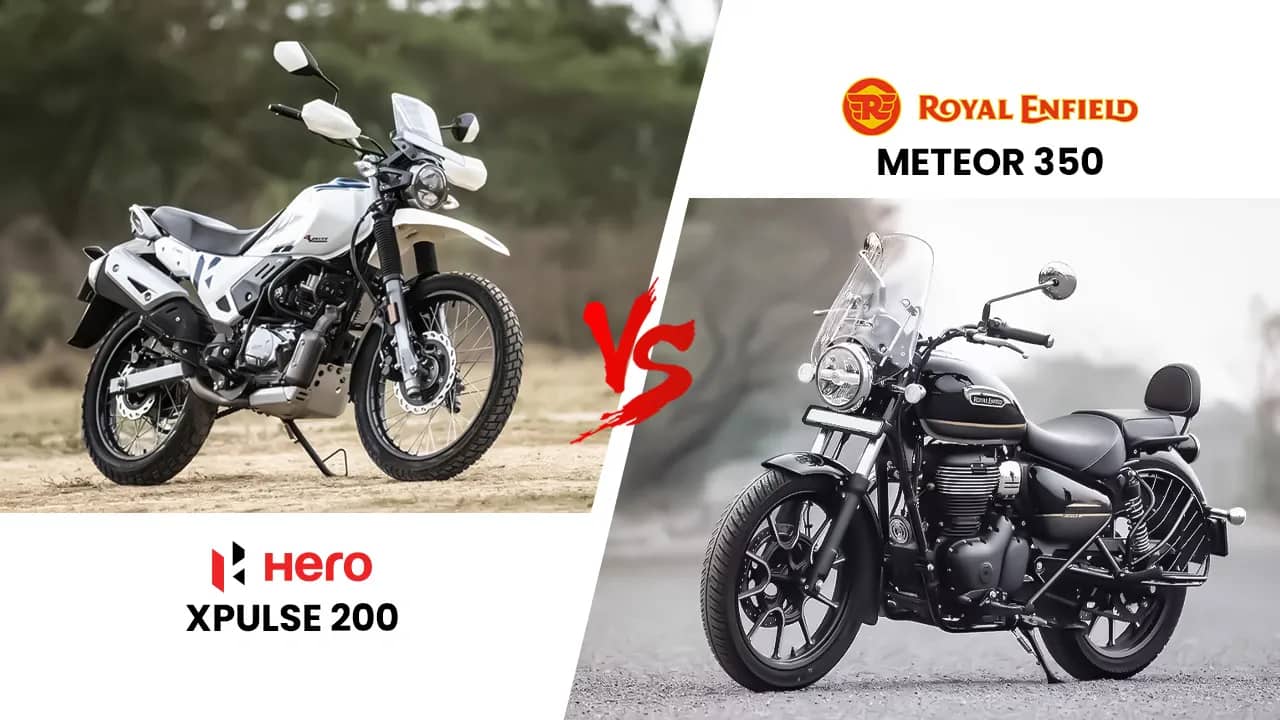
A head-to-head comparison of the Hero Xpulse 200 4V and Royal Enfield Meteor 350, covering ex-showroom and on-road pricing in Delhi, engine specs, EMI at standard financing terms, real-world fuel cost, and service cost differences — built to help Indian buyers choose between an adventure motorcycle and a cruiser in the ₹1.5-2.3 lakh segment.
Hero Xpulse 200 vs Royal Enfield Meteor 350 is the search that comes up the moment a rider's budget crosses ₹1.5 lakh and the choice stops being about which bike looks better and starts being about which bike matches how they actually ride. The Xpulse 200 4V opens at ₹1.48 lakh ex-showroom Delhi, the Meteor 350 at ₹2.06 lakh for the base Fireball trim, and that roughly ₹58,000 gap buys two completely different riding experiences for Indian buyers weighing weekend trips against daily commuting.
Two Bikes, Two Philosophies
The Xpulse 200 4V runs a 199.6cc single-cylinder engine making 18.9 bhp at 8,500rpm and 17.35 Nm at 6,500rpm, paired with long-travel suspension, 21-inch front and 18-inch rear spoked wheels, and 220mm of ground clearance. It weighs 159kg wet. None of that is cruiser territory — it's built to hop a broken patch of road near Manali or a rutted farm track outside Nashik without complaint. The Meteor 350, by contrast, carries Royal Enfield's 349.34cc J-series motor, shared with the Classic 350 and Hunter 350, tuned for 20.2 bhp at 6,100rpm and 27 Nm at just 4,000rpm. Ninety percent of that torque arrives low in the rev range, which is why the Meteor pulls cleanly from 30kmph in third gear without a downshift — something the Xpulse, revving harder for its power, simply can't match on a highway stretch.
Royal Enfield's 2025 update added a slip-assist clutch, USB Type-C charging, and Tripper navigation as standard across the Meteor range, which is worth knowing because older price listings floating around still quote the pre-update ₹1.99 lakh figure. Current ex-showroom Delhi pricing runs ₹2.06 lakh to ₹2.30 lakh depending on variant — Fireball, Stellar, Aurora, Supernova, and the Sundowner Orange special edition sit at the top. The Xpulse 200 4V's own range runs ₹1.48 lakh to ₹1.60 lakh ex-showroom between the standard and Pro variants, the latter adding rally-spec touches like an adjustable front fork.
What It Actually Costs To Ride Home
On-road, in Delhi, the Xpulse 200 4V base variant lands around ₹1.78 lakh once RTO and insurance are added, while the Meteor 350 Fireball comes to roughly ₹2.36 lakh. Financed at 20% down over 60 months at 11% interest — a standard structure most Indian dealers quote — the Xpulse works out to an EMI of about ₹3,096 a month, versus ₹4,105 a month for the Meteor. That's a real difference for someone still paying off a laptop loan or building a house fund, and it's the number that usually decides things before spec sheets even enter the conversation.
Running costs follow the same pattern. Riders report the Xpulse 200 4V returning 34-38 kmpl in mixed use; the Meteor 350, heavier at 191kg and pulling a wider torque curve at lower revs, typically settles between 28-32 kmpl on the same roads, ARAI's optimistic 41.88 kmpl claim aside. At today's petrol price of ₹103 a litre and a fairly typical 1,000km monthly usage split between weekday commuting and weekend rides, that puts fuel spend at roughly ₹2,940 a month for the Xpulse against ₹3,430 a month for the Meteor — not a huge gap, but it compounds over a three-year ownership window. Service costs tell a similar story: Hero's dealer network keeps parts and labour cheap, with a full service cycle to 10,000km typically running under ₹4,000, while Royal Enfield's J-series servicing — more oil, more labour hours per visit — usually lands closer to ₹6,500-7,000 over the same distance.
Which One Actually Fits The Weekend Rider
This is really a question about what "weekend riding" means to the buyer. If it means Himalayan foothill trails, forest roads, or the kind of route where a KTM 390 Adventure or Hero Xpulse 210 would also get a look, the Xpulse 200 4V's ground clearance and suspension travel aren't optional extras — they're the entire point of owning the bike. If weekend riding actually means a 250km highway run to a hill station with a friend on the pillion seat, the Meteor's low seat height, relaxed ergonomics, and torque-rich engine make it the far more comfortable machine for three hours in the saddle, in a way no spec sheet fully captures until you've ridden both back to back.
For most riders asking this exact question, the honest answer leans Meteor 350 if the riding stays on tarmac and comfort matters more than capability, and Xpulse 200 4V if there's any real chance of leaving the pavement or if the EMI needs to stay under ₹3,500 a month. Riders cross-shopping the Meteor should also glance at the Royal Enfield Himalayan 450, which sits in a similar price band with genuinely different intent. Check the on-road price and EMI for the Hero Xpulse 200 4V and Royal Enfield Meteor 350 in your city on Drivio.
The Hero Xpulse 200 4V (₹1.48L-₹1.60L ex-showroom) and Royal Enfield Meteor 350 (₹2.06L-₹2.30L ex-showroom) target very different weekend riders. The Xpulse's 199.6cc engine, long-travel suspension, and 220mm ground clearance suit off-road and broken-road use, while the Meteor's torquier 349.34cc J-series motor and low 765mm seat height favor comfortable highway cruising. At 20% down over 60 months, EMIs run roughly ₹3,096/month for the Xpulse versus ₹4,105/month for the Meteor; fuel and service costs also run lower on the Xpulse. Verdict: Meteor 350 for tarmac comfort, Xpulse 200 4V for off-road capability or a tighter monthly budget.