New Delhi


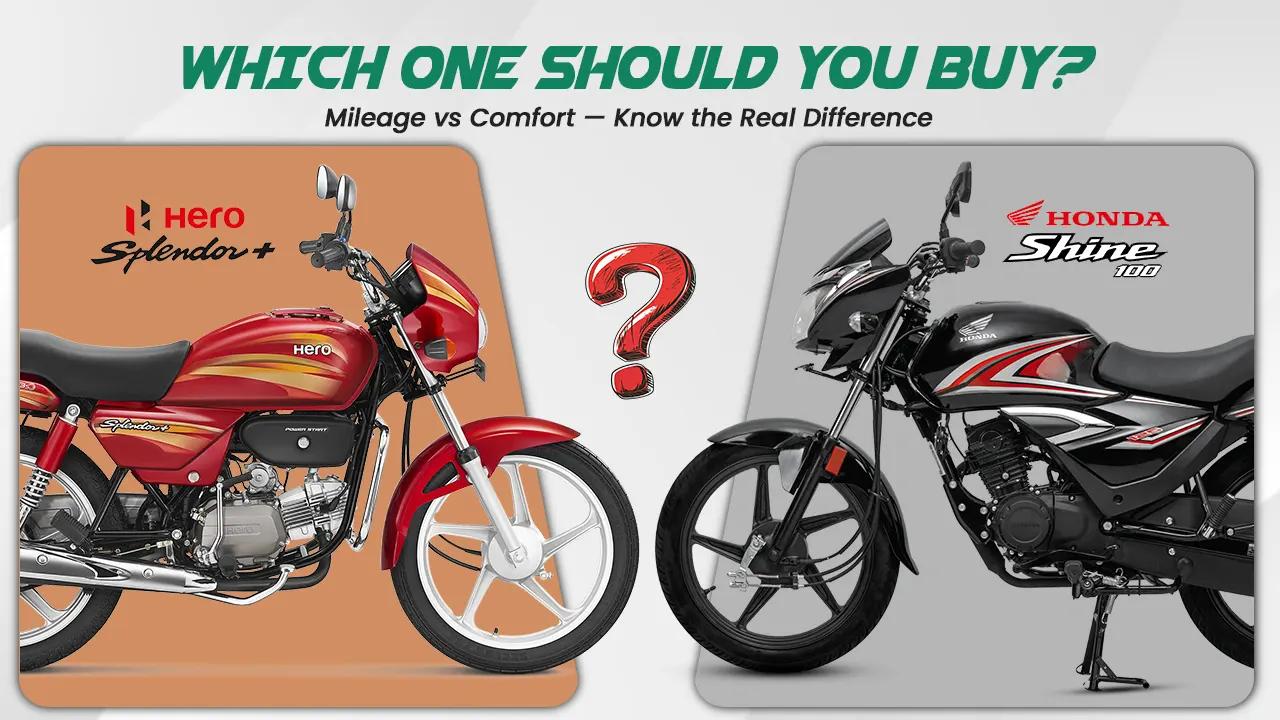

Hero Splendor+ vs Honda Shine 100: India's Two Biggest Commuter Bikes Go Head-to-Head
Featured Stories by Drivio | 23 Apr 2026
The Decision Most Indians Have to Make Twice in Their Life
You've saved up. Maybe it's your first bike. Maybe it's a replacement for the old one your father rode for a decade. The budget is set. The showrooms are close. And then someone says: "Bhai, Splendor le le" — and someone else immediately counters: "Nahi yaar, Shine 100 bahut smooth hai."
Both bikes cost roughly the same. Both promise good mileage. Both have massive service networks. And both have millions of happy owners across India.
So how do you actually choose?
This guide cuts through the noise. No spec sheets dumped on you. No paid opinions. Just a clear, honest breakdown of what each bike does well, where each one falls short, and — most importantly — which one fits your life.
What You're Actually Choosing Between
Hero Splendor+ is not just a motorcycle. It is India's bestselling two-wheeler of all time. It's been manufactured since 1994 in various forms and continues to dominate the entry commuter segment with sheer familiarity and trust. The current Splendor+ is a refined version of that legacy — simple, dependable, and deeply embedded in Indian road culture.
Honda Shine 100 is a newer entrant in the pure 100cc commuter space — Honda's direct answer to Splendor+ dominance. It carries Honda's engineering reputation, a cleaner design language, and a noticeable push toward fuel efficiency. It targets buyers who want Honda's quality badge at a Splendor-level price point.
On paper, these two are almost identical. In real life, the differences matter more than you'd think.
Engine and Performance — What It Feels Like to Ride
Both bikes run on 100cc single-cylinder engines, and neither is trying to be a sports bike. That's not the point. The question is: how does the engine feel during your 20–40 km daily commute?
The Splendor+ has a tuned OHC engine that prioritises low-end torque — the kind of pull you need at traffic lights, on crowded city roads, or while carrying a pillion. Acceleration is smooth but unhurried. At 60–70 km/h, it sits comfortably without vibration. Cross 80 and you'll notice it working harder, but for daily city riding that threshold rarely matters.
The Honda Shine 100 feels slightly more refined at the throttle. Honda's engine tuning is characteristically smooth — there's a sense of polish in how power is delivered. The CBS (Combined Braking System) braking, standard on the Shine 100, adds meaningful safety during emergency stops. First-time riders especially notice and appreciate this.
Neither bike will impress on highways. Both will impress you in traffic. If you ride mostly city roads, both perform well — but the Shine 100 feels slightly smoother out of the box, while the Splendor+ feels more "broken-in" and confidence-inspiring over time.
Edge: Shine 100 (refinement and braking feel); Splendor+ (low-end torque and proven reliability)
Mileage and Running Cost — Where It Really Counts
In India's commuter segment, mileage is not a feature. It is the feature. And this is where the battle gets serious.
Hero Splendor+ has long claimed the title of India's mileage king. Real-world usage across Indian roads consistently returns 65–70 km/l in city conditions and up to 75 km/l on open roads for conservative riders. Hero's i3S (Idle Stop-Start System) variant pushes this further by cutting the engine at idle stops.
Honda Shine 100 was engineered specifically to challenge this dominance. Honda claims figures around 65 km/l, and real-world reports from owners back this up at 60–68 km/l in mixed usage. The Shine 100 is competitive, but in a straight mileage contest, the Splendor+ still holds a marginal lead in most riding conditions.
Running cost calculation for an average Indian commuter doing 1,500 km/month at ₹102/litre (petrol):
- Splendor+ at 68 km/l: ≈ ₹2,250/month on fuel
- Shine 100 at 64 km/l: ≈ ₹2,390/month on fuel
The difference is about ₹1,700–2,000 per year. Not life-changing — but it adds up over a 5-year ownership cycle to roughly ₹10,000 in savings on fuel alone for Splendor+ owners.
Service costs are nearly identical. Spare parts for Splendor+ are marginally cheaper and more widely available — especially in smaller towns and Tier-2/3 cities.
Edge: Splendor+ (mileage and running economy, especially outside metros)
Comfort and Ride Quality — The 45-Minute Commute Test
Imagine riding your bike for 45 minutes, twice a day, on Indian roads. Potholes, speed breakers, bad patches, and stop-and-go traffic. Which bike survives that without punishing your back?
The Splendor+ has a well-cushioned seat that's been refined over decades of customer feedback. The seating position is upright and ergonomically suited to Indian riders of average height (5'4"–5'9"). Suspension handles broken roads adequately. Long-time Splendor owners rarely complain about fatigue on rides under an hour.
The Honda Shine 100 offers a noticeably better-shaped seat — slightly wider and more supportive for taller riders. The suspension travel feels a little more forgiving on sharp bumps. The overall build quality of plastics and fit-finish is visibly better than the Splendor+, which matters if you care about how the bike looks and feels in the hand.
For riders who do 30 km or less daily, both are equally comfortable. For those pushing 50+ km daily, the Shine 100's seat and suspension marginally reduce fatigue over extended rides.
Edge: Shine 100 (seat comfort and build quality feel)
Maintenance and Reliability — The 5-Year Question
This is where brand trust and real-world ownership data should guide your decision more than showroom promises.
Hero has the largest two-wheeler service network in India — over 9,000 touch points across the country. In most Tier-3 towns, the local mechanic has serviced a Splendor before you were born. Parts availability is unmatched. The simplicity of the Splendor+'s engine means even roadside mechanics can fix most issues without a Hero-authorised workshop. For riders in smaller cities, semi-urban areas, or those who travel frequently through interior India, this is not a small advantage. It is a lifeline.
Honda has a strong and growing network — over 6,000+ service points — and HMSI's quality control is exceptional. The Shine 100, being relatively new, doesn't yet have the 30-year parts ecosystem that Splendor+ enjoys. Honda-authorised workshops are excellent, but they're more metro and Tier-1 concentrated. In Tier-3+ towns, a Honda mechanic is less common than a Hero one.
Both bikes are built to last. Honda's engineering typically produces engines that age very well. The Splendor+'s mechanical simplicity means fewer things go wrong in the first place.
Edge: Splendor+ (service network reach, parts availability, mechanic familiarity)
Resale Value and Long-Term Ownership
If you plan to sell the bike after 4–5 years, resale value matters as much as the purchase price.
Splendor+ holds resale value exceptionally well. A 5-year-old Splendor+ in good condition easily commands 55–65% of original value in the used market. Demand is constant and buyers exist everywhere. This is partly because of trust and partly because replacement parts are cheap — so used buyers don't fear owning an older Splendor.
Honda Shine 100 being newer in the 100cc segment hasn't yet built the same depth of used-market demand as Splendor+. The Honda badge helps, but resale value currently trails the Splendor+ by 8–12%. As the model matures and builds a track record, this gap may close — but for buyers planning a 3–5 year ownership cycle right now, Splendor+ gives a more predictable exit.
Edge: Splendor+ (resale value and used-market liquidity)
How These Two Bikes Are Actually Different
Strip away the spec sheets and here's what separates them in honest terms.
The Splendor+ is a bike you trust before you've ridden it. Its reputation does half the work. It's optimised for economy, longevity, and universal serviceability across India's extremely varied terrain and infrastructure. Everything about it communicates practicality — including the spartan fit and finish that some buyers find underwhelming. You're not buying it for how it looks. You're buying it for what it does, year after year.
The Shine 100 is a bike you notice when you sit on it. The quality of materials, the CBS braking, the smoother throttle response — these are tangible improvements that Honda has built deliberately to chip away at Splendor's dominance. It's a bike aimed at buyers who want the reliability of Honda engineering but don't want to feel like they compromised on quality for the price. Its weakness is the smaller service footprint outside major cities and a used-market track record that's still being written.
One is a proven generational workhorse. The other is a carefully engineered challenger that promises to get there.
Who Should Buy the Hero Splendor+
Buy the Splendor+ if you live in a Tier-2 or Tier-3 city where authorised Honda service centres are sparse. Buy it if your commute is under 30 km and maximum fuel savings matter more than riding feel. Buy it if you plan to resell in 3–5 years and want maximum liquidity in the used market. Buy it if reliability over a decade — not just three years — is your primary concern.
It's the right bike for daily wage earners, gig economy riders logging high kilometres, and anyone who values low cost of ownership over everything else. It is also the right bike for buyers in rural India where finding a Hero mechanic at 8 PM on a highway is genuinely possible.
If your riding life is defined by utility and economics, Splendor+ wins every time.
Who Should Buy the Honda Shine 100
Buy the Shine 100 if you're a first-time rider who values the safety of CBS braking. Buy it if you live in a metro or Tier-1 city where Honda's service network is dense and easily accessible. Buy it if you ride 40–50 km daily and the marginally better seat and suspension translate into real comfort gains for you.
It's the right bike for college students and young professionals who care about how the bike looks and feels, not just what it costs per kilometre. Honda's brand perception also carries social weight in certain buyer contexts — particularly among buyers for whom the purchase is also a statement.
If you prioritise ride refinement and Honda's engineering pedigree at an accessible price, the Shine 100 is a very compelling choice.
Final Verdict
There is no bad choice here. Both bikes will serve you faithfully for years. But if you asked a straight question, here is a straight answer.
Buy the Hero Splendor+ if you are in Tier-2 India, focused on economy, and plan to sell the bike within 5 years. It remains the most practical, most affordable-to-own, and most universally reliable commuter bike in the country. Its 30-year track record is not marketing — it's millions of owners across every state and road condition in India.
Buy the Honda Shine 100 if you are in a metro, value CBS safety, and want a slightly more refined daily ride. Honda's engineering quality is not in question. The Shine 100 is a genuinely excellent motorcycle, and if your usage context suits it, it will not disappoint.
For the widest possible buyer — the average Indian commuter making a practical, long-term decision — the Splendor+ remains the safer bet. The Shine 100 is the smarter bet for a specific kind of urban buyer who knows exactly what they're choosing and why.
Go to the showroom. Sit on both. And trust what your back and your budget tell you.