Bike vs Scooter for Your 25 km Office Commute: Which One Actually Makes Sense in 2026?
Overview
Bike vs Scooter for Your 25 km Office Commute: Which One Actually Makes Sense in 2026? brings key updates for two-wheeler buyers in India. The Commute Nobody Talks About Honestly Picture this: It's 8:45 AM on a Tuesday in Bengaluru or Gurugram. You have 25 kilometres to cover. The signal at the main junction
The Commute Nobody Talks About Honestly
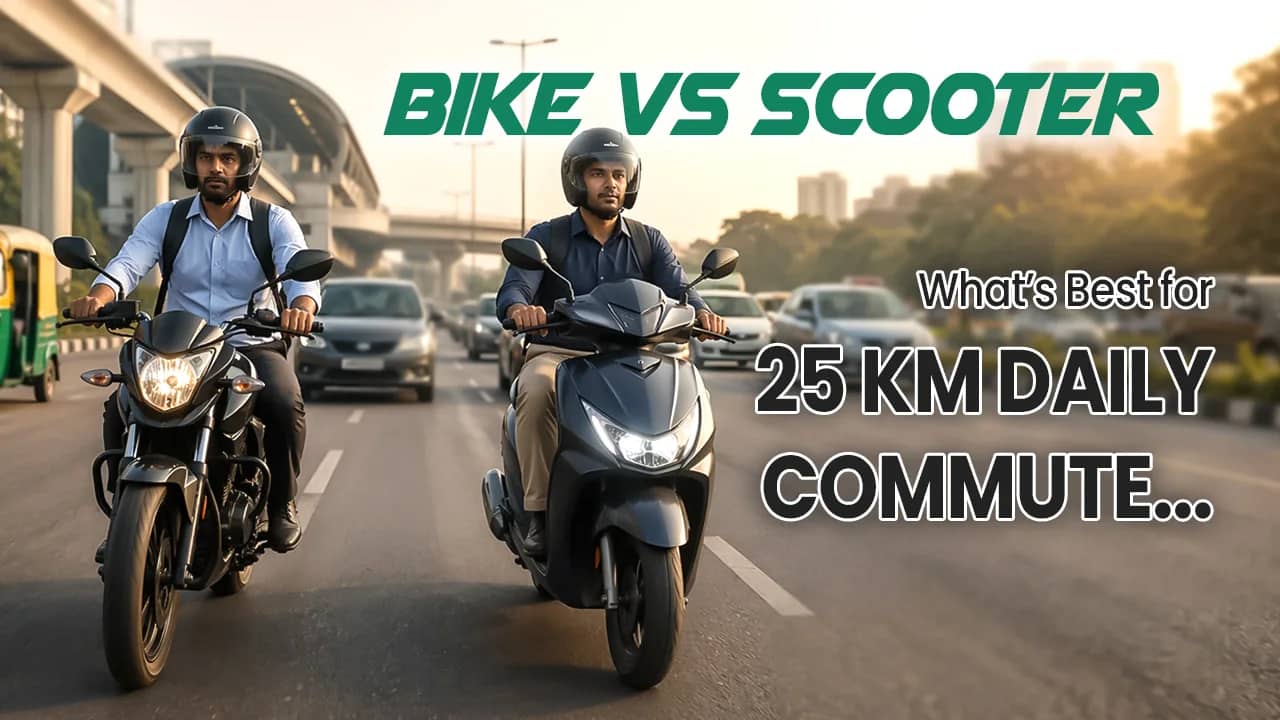
Picture this: It's 8:45 AM on a Tuesday in Bengaluru or Gurugram. You have 25 kilometres to cover. The signal at the main junction is on its third cycle. A delivery truck has taken up one and a half lanes. Your phone says 55 minutes to office. And you're on two wheels — which means you're threading through gaps no car can touch, but also absorbing every pothole, every sudden brake, every gust of diesel exhaust directly.
By the time you arrive, the question isn't just did you make it on time. It's how functional are you for the next eight hours?
A 25 km one-way commute — 50 km a day, roughly 1,100 km a month — is not a casual ride. It is a physical and mechanical stress test, repeated five or six times a week. Whether you ride a bike or a scooter makes a surprisingly large difference in that experience, and the wrong choice costs you in fatigue, money, and time in ways that compound quietly over months.
This article cuts through the noise and gives you a direct, data-grounded answer.
What Actually Matters at 25 Kilometres
Before comparing vehicles, it helps to define the right criteria. For a commute of this distance in an Indian city, five factors determine your daily quality of life:
Riding fatigue — How drained are you after the ride, before the workday even starts? For a sub-10 km commute this barely matters. At 25 km each way, it's the single most underrated variable.
Fuel economy — At 1,100 km/month, even a 10 km/l difference in mileage translates to a meaningful monthly cost gap. Over a year, it becomes significant.
Traffic agility — Can you make progress during peak-hour gridlock without burning energy on constant gear changes, lane adjustments, and standing restarts?
Storage and practicality — Laptop bag, lunch box, occasional grocery run. How much of your mental load does the vehicle absorb?
Maintenance predictability — Not just cost, but frequency of intervention and ease of access to service centres across Indian cities.
These five lenses will anchor the entire comparison that follows.
The Case for a Bike — Where It Genuinely Earns Its Keep
A conventional commuter motorcycle — think Honda Shine 125, Bajaj Pulsar N125, or TVS Raider 125 in the 125–160cc range — has a structural advantage over a scooter the moment your commute extends beyond urban crawl.
Stability at sustained speed. Indian city commutes are rarely 100% stop-and-go. Most 25 km routes have at least two or three stretches — ring roads, expressways, or arterial connectors — where traffic moves at 60–80 km/h for minutes at a time. A bike's longer wheelbase, lower centre of gravity, and firmer suspension geometry make it noticeably more planted at these speeds. You expend less physical energy holding your line. A scooter with its smaller 12-inch wheels and higher centre of mass requires more active correction, especially on broken or uneven tarmac.
Fuel efficiency at highway speeds. Scooters are optimised for low-speed urban use. Their CVT (continuously variable transmission) is efficient in city crawl, but at 60 km/h and above, it becomes less economical than a manual geared engine operating near its torque sweet spot. In mixed commute conditions, a well-tuned 125cc bike routinely delivers 55–65 km/l, often outperforming a comparable scooter by 8–12 km/l on routes with any meaningful highway section.
Long-ride fatigue profile. The riding posture on a standard commuter bike — slightly forward lean, feet below hips, back naturally engaged — is biomechanically more sustainable over 45–60 minute rides than a scooter's upright posture with feet flat and forward. Counterintuitively, the "relaxed" scooter posture causes lower back compression and hip flexor fatigue faster on longer rides, because the spine isn't being actively supported by a forward lean.
Resale and longevity. In the Indian used vehicle market, geared commuter motorcycles in the 125–150cc segment retain value better and have longer mechanical lifespans on average, due to their simpler drivetrain and wider service network penetration across Tier 1 and Tier 2 cities alike.
Section 3: The Case for a Scooter — Where It Makes Commuting Genuinely Easier
A modern automatic scooter — Honda Activa 6G, TVS Jupiter 125, Suzuki Access 125, or Ather 450 in the EV segment — is not the slow city vehicle it used to be. In 2026, mid-segment scooters have closed much of the performance gap, and their real-world advantages for city commuting are concrete.
No gear fatigue in dense traffic. This is the scooter's single biggest advantage on a congested Indian commute. In stop-and-go conditions — signals, school zones, narrow market roads — a geared bike requires constant clutch engagement and disengagement, left-hand fatigue, and micro-decisions about gear selection that accumulate over 45 minutes. An automatic scooter eliminates all of that. You throttle and brake. In genuinely heavy traffic, this reduces mental load and wrist/hand fatigue significantly.
Under-seat storage as a game-changer. A typical scooter offers 18–25 litres of under-seat storage — enough for a 15-inch laptop bag, a small lunch box, and a rain jacket simultaneously. On a bike, everything goes on your back. Over 25 km on rough urban roads, a loaded backpack adds spinal load and shoulder strain. This is not a minor comfort issue; it's a cumulative health one.
Accessibility and inclusive usability. For riders wearing formal office wear, sarees, or suits, a scooter's step-through frame is meaningfully more practical. The learning curve is lower, the confidence threshold is lower, and the social context of scooter riding in Indian offices remains broad and neutral across gender, age, and seniority.
Urban manoeuvrability at low speeds. Below 30 km/h, a scooter's smaller footprint and tighter turning radius gives it the edge in cramped lanes, tight parking manoeuvres, and multi-direction weaving through gridlock. It feels lighter to handle even if it isn't significantly lighter on paper.
The Real-Life Comparison
Traffic Handling
In genuinely dense urban traffic — Bengaluru's Silk Board, Mumbai's WEH, Delhi's NH48 corridor — a scooter edges ahead purely because of the automatic transmission. Clutchless riding in slow-and-go conditions is measurably less tiring. However, on routes where traffic has variable density (congested for 10 km, then relatively free for 15 km), a bike makes up that deficit and then some. For 25 km routes with mixed traffic profiles, the difference is narrower than scooter advocates claim.
Fuel Cost Over a Month
At 1,100 km/month and petrol at approximately ₹103–105/litre across major Indian cities in 2026:
- A commuter bike averaging 60 km/l: ₹1,880–1,920/month
- A scooter averaging 48 km/l: ₹2,360–2,400/month
That's a difference of roughly ₹480–520 per month, or ₹5,800–6,200 per year. Over three years, the bike's fuel economy advantage pays for a full service cycle. On EV scooters like the Ather 450X or Ola S1 Pro, the monthly running cost drops to ₹300–450 at current electricity rates, which changes the calculus entirely if charging infrastructure at home or office is reliable.
Maintenance
Geared bikes have more components — clutch cable, gear linkage, chain and sprocket — but these are well-understood, widely serviceable, and inexpensive to maintain at any roadside mechanic across India. Scooter CVT belts, rollers, and variator assemblies require periodic replacement (typically every 20,000–25,000 km) and are more expensive per service visit, with fewer informal service options in smaller towns. In metro cities, both are equally accessible. In Tier 2 cities, bikes win on serviceability hands down.
Riding Fatigue
This is where the comparison gets nuanced. On a pure city route (under 60 km/h average), scooters reduce hand and wrist fatigue. On a mixed or semi-highway route, bikes reduce postural and spinal fatigue. For most Indian 25 km commutes — which involve both — the fatigue profiles roughly equalise by the end of a ride. The deciding factor is which type of fatigue you're more sensitive to: gear-change hand strain (favours scooter) or postural back load (favours bike).
The Hidden Factors That Change Everything
Rain
Monsoon commuting is where scooters lose significant ground. Their smaller 12-inch wheels offer less stability on wet roads. The flat-foot, upright posture makes rain deflection worse. A bike's geometry, slightly larger tyre contact patch, and forward lean posture give meaningfully better wet-road control. If your city gets four months of serious monsoon (Mumbai, Pune, Bengaluru, Hyderabad, Chennai), weight this heavily.
Parking
Scooters are more compact and easier to park in tight basement stalls, building lobbies, and on-street spots. Many IT parks and commercial complexes have designated two-wheeler zones with insufficient width for a bike's wider stance and handlebars. In dense urban office zones, scooter parking is genuinely less stressful and less time-consuming.
Office Lifestyle
If you carry gear — a laptop, gym bag, work documents — a scooter's storage absorbs that load off your body. If you ride in formal clothing, a scooter's frame is more forgiving. If you need to occasionally do weekend rides or step outside the city on a long day trip, a bike offers a meaningfully better experience beyond urban limits. Your vehicle choice should match not just the commute, but the entire use pattern surrounding it.
Who Should Choose a Bike
Choose a commuter motorcycle if:
- Your 25 km route includes more than 8–10 km of arterial roads or highway-like conditions where traffic moves above 55 km/h
- You commute in a city with significant monsoon exposure and ride through rain regularly
- Fuel economy over 3–5 years is a priority and you're not considering an EV
- You ride in casual or semi-formal clothes and carry minimal daily gear
- You are in a Tier 2 city or plan to relocate — service access matters here
- You occasionally ride beyond city limits for personal or work travel
Strong 2026 picks: Honda SP 125, Bajaj Pulsar N125, TVS Raider 125, Honda Shine 100 (for budget-first buyers)
Who Should Choose a Scooter
Choose an automatic scooter if:
- Your route is predominantly inner-city with heavy stop-and-go traffic for more than 15 of the 25 km
- You carry a laptop or work bag daily and don't want it on your back during the ride
- You ride in formal or traditional clothing
- You share the vehicle with a family member who is not comfortable on a geared bike
- You are open to an EV and have reliable home/office charging — this is where the scooter format completely dominates on total cost of ownership
Strong 2026 picks: Honda Activa 125, TVS Jupiter 125 (petrol), Ather 450X / Ola S1 Pro / Bajaj Chetak (EV, for city-first buyers with charging access)
Final Verdict — No Fence-Sitting
For a 25 km Indian city commute in 2026, the scooter wins in pure urban conditions; the bike wins in mixed or semi-highway conditions.
More precisely: if more than 60% of your daily route involves speeds below 40 km/h in dense traffic, and you carry gear, the scooter is the better commuting machine by a clear margin — especially if you go electric. If your route has meaningful stretches of faster-moving roads, involves monsoon riding, or if you want a vehicle that works equally well for city and occasional longer trips, a geared commuter bike in the 125–150cc range is the more rational, economical, and physically sustainable choice.
The single most important factor that most buyers ignore: postural fatigue over 50 km daily is a health issue, not a comfort preference. Make the decision based on your actual route, your actual load, and your actual use pattern — not on what your colleague rides or what looks better in the parking lot.
Picture this: It's 8:45 AM on a Tuesday in Bengaluru or Gurugram. You have 25 kilometres to cover. The signal at the main junction is on its third cycle. A delivery truck has taken up one and a half lanes. Your phone says 55 minutes to office. And you're on two wheels — which means you're threading through gaps no car can touch, but also absorbing every pothole, every sudden brake, every gust of diesel exhaust directly.