New Delhi


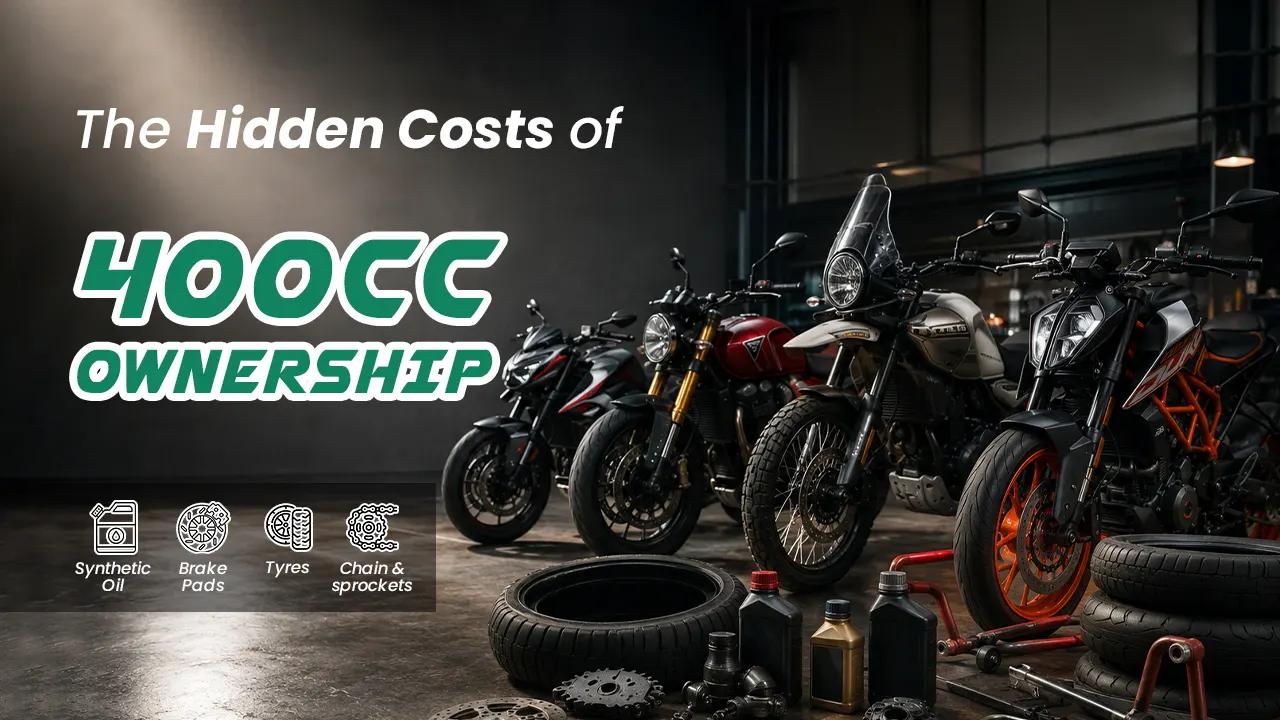

The Hidden Costs of 400cc Ownership: Synthetic Oil, Brake Pads & Tyres
Featured Stories by Drivio | 20 May 2026
The real 400cc bike maintenance cost conversation rarely happens in showrooms. As of May 2026, thousands of Indian buyers are calculating EMIs and fuel economy while completely ignoring what sits beneath the surface — the recurring consumables that quietly drain ₹25,000 to ₹45,000 every year depending on how hard and how far you ride. Synthetic engine oil, sintered brake pads, radial tyres, chain and sprocket kits, coolant flushes, and labour charges at authorised service centres are the true cost of running a modern 400cc machine in India. None of these expenses appear in a brochure. All of them appear on your workshop bill.
How Much Does a 400cc Bike Cost to Maintain in India?
The honest answer is: significantly more than most buyers expect. A 400cc liquid-cooled engine with ride-by-wire, USD forks, dual-channel ABS, and a slipper clutch is an entirely different mechanical proposition compared to a 200cc commuter. These motorcycles demand premium fully synthetic oil, have tighter service windows, and carry imported parts that carry a pricing premium at every authorised dealership. When you factor in the reality of Indian traffic — stop-go urban commuting, 40-degree summer heat, dust-laden air on highways — the consumable wear rate climbs further still.
The Bajaj Pulsar NS400Z sits at the more accessible end of the 400cc ownership spectrum, with service costs roughly comparable to the broader Bajaj ecosystem. The KTM Duke 390, however, operates on a tighter maintenance schedule with fully synthetic oil mandatory from day one, and KTM's Austrian-origin parts pricing is noticeably steeper than domestic alternatives. The Royal Enfield Himalayan 450 draws a different kind of owner — typically a touring-focused rider who will accumulate kilometres faster and stress consumables harder. The Triumph Speed 400, backed by Bajaj's service infrastructure, has arguably the most accessible authorised network for a premium European nameplate, but its imported components still carry a cost premium over domestically assembled motorcycles.
The Synthetic Oil Question Nobody Asks
Every 400cc liquid-cooled performance engine in this segment requires fully synthetic oil — there is no compromise here. Oil change intervals typically fall between 3,000 and 5,000 kilometres depending on the motorcycle and riding conditions. In the real world, bumper-to-bumper Gurugram or Bengaluru traffic degrades synthetic oil faster than open highway riding, shortening the effective service window closer to 3,000km for daily commuters.
A quality fully synthetic oil suited for these engines — brands like Motul 7100, Shell Advance Ultra, or manufacturer-specified variants — costs between ₹600 and ₹900 per litre, with most 400cc engines requiring around 1.5 to 2 litres per change. Add the oil filter at ₹300–₹500, and a single oil service crosses ₹1,500–₹2,200 in parts alone before labour. Riders covering 15,000 kilometres annually can expect three to four oil changes per year, pushing annual synthetic oil costs to ₹5,000–₹8,000 comfortably.
Brake Pads: Where Touring Habits Bite Hard
Factory-fitted sintered brake pads on 400cc motorcycles typically last between 8,000 and 15,000 kilometres on the front axle depending on riding style, with rear pads lasting considerably longer under normal use. The problem is that brake pad wear is rarely linear — mountain touring, where riders are repeatedly braking hard on descents like those on Leh or Spiti routes, can halve the lifespan of a set of front pads. A weekend tourer who covers 3,000km in the hills will see more pad wear than an office commuter doing the same distance.
Replacement sintered pads for the Duke 390 and Speed 400 cost ₹800–₹1,500 per axle for OEM-specification parts. Premium aftermarket options from brands like EBC or Brembo-spec pads for the Triumph push closer to ₹2,000–₹2,500 for the front set. Riders who push their machines on track days or canyon roads should budget a complete brake pad replacement — front and rear — at least once annually, adding ₹2,000–₹4,000 to the ownership cost.
Tyres: The Single Largest Consumable Expense
Tyres are where 400cc bike maintenance cost conversations truly get uncomfortable for prospective buyers. The softer rubber compounds used on performance-focused 400cc machines wear significantly faster than the harder compounds on commuter-segment tyres. Indian summers, where tarmac temperatures regularly exceed 55 degrees Celsius in May and June, accelerate compound degradation on the southern and central highway belt. Radial tyres suited for this segment include the Apollo Alpha H1, Reise tourer tyres, MRF Steel Brace, and the CEAT SportRad — all of which sit between ₹3,500 and ₹6,500 per tyre for 17-inch fitments.
Aggressive street riders report front tyre replacement at 10,000–12,000km and rear tyre replacement every 7,000–9,000km on performance compounds. Touring-oriented riders on the Himalayan 450 with harder compound fitments can stretch rear tyre life to 12,000–15,000km, but the riding profile matters enormously. Factoring in one complete tyre replacement per year for an average 12,000–15,000km rider costs ₹8,000–₹13,000 including fitment and wheel balancing. This single line item frequently shocks buyers who budgeted only for EMI and petrol.
Chain, Sprocket, and the Quiet Kilometre Counter
The chain and sprocket kit on a 400cc performance motorcycle is not a lifetime component. High-torque, high-rpm operation — combined with the realities of Indian road conditions, irregular lubrication, and occasional chain slack neglect — typically results in complete chain and sprocket replacement between 15,000 and 25,000 kilometres. A quality OEM-specification chain and sprocket kit for the Duke 390 or Speed 400 costs ₹3,500–₹6,000 including fitment. Regular lubrication with a quality chain lube — roughly ₹400–₹700 for a can that lasts several months — can extend this window meaningfully, but the replacement cost remains inevitable.
Labour Charges and the Service Network Reality
Authorised service centre pricing varies considerably across the four motorcycles in this comparison. KTM dealerships typically charge ₹800–₹1,200 per hour for skilled labour, and a full scheduled service — not just an oil change — can touch ₹3,000–₹5,000 in labour alone. Royal Enfield's larger and more distributed network keeps labour costs somewhat more competitive at ₹600–₹900 per hour, while the Triumph Speed 400 benefits from Bajaj's extensive 1,500-plus-centre network making parts availability and labour pricing considerably more reasonable than buyers of legacy imported motorcycles experience. The NS400Z has the most accessible service cost structure of the four, consistent with Bajaj's domestic manufacturing advantage.
| Motorcycle | Engine | Max Power | Peak Torque | Real Mileage | Annual Maintenance Estimate | Tyre Replacement Cost | Brake Pad Cost (Front) | Ex-showroom Price Delhi |
| KTM Duke 390 | 399cc liquid-cooled single | ~46 PS | ~39 Nm | 28–32 km/l | ₹18,000–₹28,000 | ₹7,500–₹12,000 | ₹1,000–₹1,800 | ~₹3.20 lakh |
| Royal Enfield Himalayan 450 | 452cc liquid-cooled single | ~40 PS | ~40 Nm | 30–35 km/l | ₹15,000–₹22,000 | ₹7,000–₹11,000 | ₹800–₹1,400 | ~₹3.05 lakh |
| Triumph Speed 400 | 398.15cc liquid-cooled single | ~40 PS | ~37.5 Nm | 30–35 km/l | ₹16,000–₹24,000 | ₹8,000–₹13,000 | ₹1,200–₹2,000 | ~₹2.33 lakh |
| Bajaj Pulsar NS400Z | 373.3cc liquid-cooled triple | ~40 PS | ~37.5 Nm | 28–32 km/l | ₹12,000–₹18,000 | ₹6,500–₹10,000 | ₹700–₹1,200 | ~₹1.98 lakh |
What the Numbers Actually Mean for Indian Buyers
The Pulsar NS400Z is the pragmatic choice for first-time 400cc buyers who want the segment's performance without the premium ownership weight. Its domestic manufacturing base, Bajaj service network, and affordable parts pricing make it the cheapest 400cc to maintain across most kilometre brackets. The Speed 400 punches above its price in terms of brand and quality, and its Bajaj-powered service network provides real-world comfort that no other premium nameplate can match at this price point.
The Himalayan 450 becomes expensive for owners who tour hard — brake pads, tyres, and chain wear will all arrive faster when you're loading the bike with luggage and riding 500km days. The Duke 390 remains the most dynamically accomplished machine in the comparison but carries the highest long-term ownership cost, particularly past the 20,000km mark when suspension service and throttle body cleaning enter the picture.
First-time buyers moving up from 200–250cc motorcycles almost universally underestimate how different the consumable economics are. The jump from a Honda CB300R or Bajaj Dominar 400 to a Duke 390 or Speed 400 is not just a performance upgrade — it's a commitment to a different annual expenditure pattern. Riders who cover under 8,000km a year on gentle roads will find the gap manageable. Riders who commute daily in Delhi NCR heat and tour twice monthly will hit the upper end of these maintenance estimates fast.
The smartest ownership choice for long-term value right now is the Triumph Speed 400 — the combination of Bajaj service accessibility, competitive parts pricing, and genuine premium provenance makes it the most financially balanced option in the segment. If budget is the primary concern, the NS400Z delivers the most performance per rupee of ownership cost. The Duke 390 is for riders who ride hard and accept the bill that follows. Check the on-road price and EMI for these 400cc motorcycles in your city on Drivio.