Best Electric Scooter for Delivery in India: What Zomato, Swiggy & Blinkit Riders Should Actually Buy in 2026
Overview
Best Electric Scooter for Delivery in India: What Zomato, Swiggy & Blinkit Riders Should Actually Buy in 2026 brings key updates for two-wheeler buyers in India. The best electric scooter for delivery in India is not the cheapest one on the lot — it is the one that survives 100-plus kilometres daily, holds up through monsoon
The best electric scooter for delivery in India is not the cheapest one on the lot — it is the one that survives 100-plus kilometres daily, holds up through monsoon puddles, charges overnight without drama, and still makes financial sense after 18 months of hard use. As of May 2026, delivery riders across Delhi, Bengaluru, Hyderabad, and Mumbai are switching to EVs in meaningful numbers, primarily because running costs have dropped to roughly ₹0.20–0.25 per kilometre on electric versus ₹2.00–2.10 per kilometre on petrol at the current pump price of approximately ₹103/litre. That difference, compounded across 90–120 km of daily delivery duty, adds up to savings of ₹4,000–6,500 per month — money that goes directly into a rider's pocket, not into a fuel tank.
Why Running Cost Is the Only Number That Really Matters
A Zomato or Swiggy rider clocking 2,500–3,500 km per month does not evaluate a scooter the way a weekend commuter does. Seat comfort matters less than underseat storage. Top speed matters less than low-speed torque in choked traffic. And showroom aesthetics matter far less than the service centre being within 5 kilometres of the delivery zone.
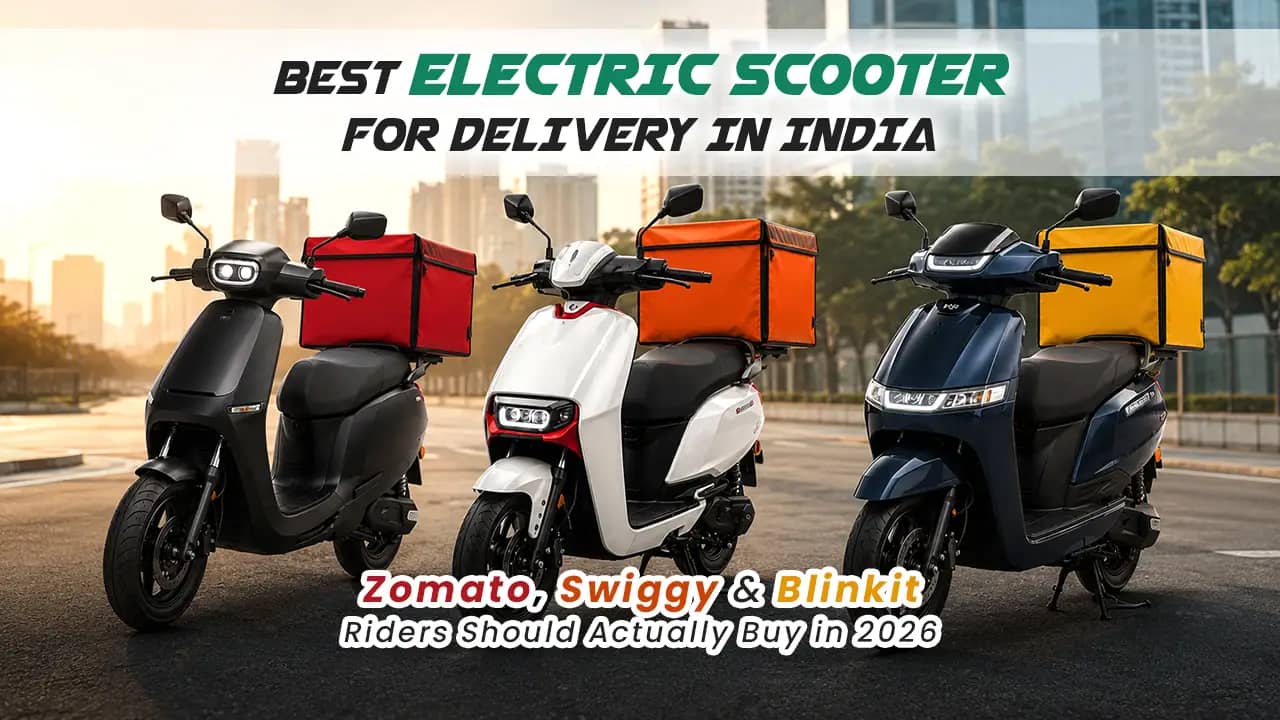
With that framework, three electric scooters stand out clearly in the Indian market right now — the Ola S1 X+, the Hero Vida V2 Pro, and the TVS iQube ST. Each targets a slightly different kind of delivery rider, and the choice depends on your city, your daily target, and how disciplined you are about overnight charging.
Ola S1 X+ — The Numbers-First Choice
At an ex-showroom price of ₹1,09,999 and an on-road price in Delhi of approximately ₹1,23,000–1,26,000 (after FAME II subsidy adjustments), the Ola S1 X+ with the 3.97 kWh battery is the most-discussed EV among gig economy riders for good reason. Its IDC-certified range sits at 151 km, and real-world city range in Eco mode — which most delivery riders use — lands between 100 and 115 km depending on load and traffic density. That is enough to complete a full delivery shift without needing a midday top-up.
The 36-litre underseat boot is among the largest in its segment, comfortably fitting a delivery bag and a rain jacket without the kind of boot-lid wrestling that smaller competitors make you do. Regenerative braking — adjustable across three levels — is calibrated well enough for city riding, and the single-channel front brake setup is adequate for urban speeds, though riders pushing 70–80 kmph consistently on arterial roads will find the braking confidence short of what the TVS iQube offers.
Heat management during summer afternoons is the S1 X+'s most discussed real-world concern. Extended high-throttle use in 42°C weather can trigger thermal throttling, noticeably reducing power. It is not a safety issue, but it is frustrating during peak hours.
Where the Ola Falls Short for Delivery Use
The service infrastructure, while expanding, is still uneven outside Tier-1 cities. Riders in smaller metros should verify Ola service coverage before committing. Software updates have improved stability, but early units in some fleets showed suspension calibration that felt underdamped on broken urban roads — the kind of pothole-riddled stretches that are unavoidable in most Indian cities. Post-2024 production variants are better sorted.
Hero Vida V2 Pro — The Range Argument
The Hero Vida V2 Pro at ₹1,09,999 ex-showroom carries a 3.94 kWh battery and claims 165 km IDC range, which in real-world mixed city riding typically translates to 120–130 km — the highest usable range in this price bracket by a meaningful margin. For riders working long shifts or covering wider delivery zones in cities like Bengaluru and Delhi NCR, that extra cushion removes the low-battery anxiety that can sabotage delivery efficiency in the final two hours of a shift.
Hero's dealer and service network is its strongest card. With over 900 touchpoints across India, a Vida V2 Pro rider in Jaipur, Coimbatore, or Lucknow has genuine access to spares and trained technicians — something neither Ola nor Ather can match outside their core markets. The suspension setup — conventional telescopic forks up front and twin shock absorbers at the rear — is tuned conservatively but handles broken road surfaces better than it looks on paper.
The removable battery option on certain Vida variants is particularly relevant for riders living in apartments where running a charging cable to a parking lot is impractical. Being able to carry the battery unit upstairs is a real operational advantage.
TVS iQube ST — Pay More, Worry Less
At ₹1,30,000–1,35,000 ex-showroom, the TVS iQube ST with its 5.1 kWh battery is priced above typical delivery-rider budgets, but it earns its premium through sheer build quality and reliability. Real-world range hovers around 110–120 km, which is slightly below the Vida V2 Pro, but the iQube's dual-channel disc brakes, heavier build quality, and TVS's obsessively deep service network make it the preferred choice for fleet operators and riders who log serious kilometres month after month.
The suspension — telescopic forks and a monoshock — is the most composed of the three over speed breakers and rough patches. Riders who have switched from petrol scooters like the Honda Activa or TVS Jupiter frequently cite the iQube's ride quality as the closest to what they were used to. That matters when your workday involves 60–80 speed breakers over 100 km.
A Note on Charging Practicality
Every EV on this list charges fully in 5–7 hours on a standard 15-amp home socket. The iQube supports TVS's fast-charging infrastructure at select SmartXonnect stations, but for most delivery riders, overnight home charging remains the practical standard. If your parking situation does not allow easy home charging, the Vida V2 Pro's removable battery option is worth prioritising over everything else.
Who Should Buy What
The Ola S1 X+ suits riders in Tier-1 cities with home charging access who want maximum boot space and a lower upfront cost. The Hero Vida V2 Pro is the clear pick for riders covering longer daily distances, those in smaller cities needing Hero's service reach, or anyone dealing with a complex charging setup. The TVS iQube ST is for riders who can stretch the budget and want the most reliable, refined ownership experience — particularly on fleets where downtime is directly lost income.
If budget is the primary constraint, the Bajaj Chetak at approximately ₹1,06,000 and the Ather Rizta at around ₹1,09,999–1,14,999 are worth evaluating, though both offer somewhat lower real-world range and a narrower sweet spot for heavy daily use.
At ₹103/litre petrol and electricity costs that have held relatively stable, the case for switching to an electric scooter for delivery work in India has never been stronger numerically. The payback period on any of these three scooters — against a petrol alternative like the Honda Activa 6G — is now under 18 months for a full-time delivery rider.
Check the on-road price and EMI for the Ola S1 X+, Hero Vida V2 Pro, or TVS iQube ST in your city on Drivio.
The best electric scooter for delivery in India is not the cheapest one on the lot — it is the one that survives 100-plus kilometres daily, holds up through monsoon puddles, charges overnight without drama, and still makes financial sense after 18 months of hard use.