New Delhi


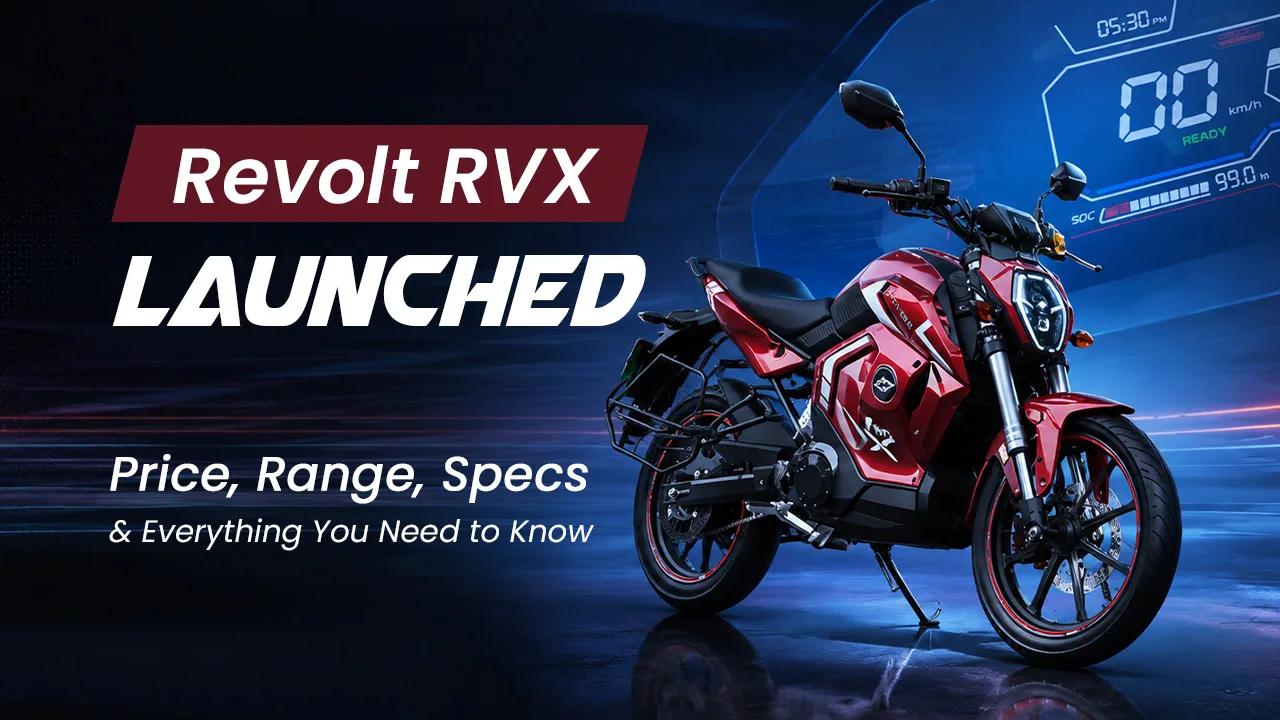

Revolt RVX Launched: Price, Range, Specs and Everything You Need to Know
News by Drivio | 6 Jul 2026
Revolt RVX launched in India this week at an introductory ex-showroom price of around ₹1.24 lakh, and it arrives as the most powerful electric motorcycle the Gurugram-based company has built so far. For a brand best known for the RV400's retro styling and swappable-battery convenience, the RVX marks a shift toward performance: a mid-drive motor, sharper acceleration, and a design language that borrows heavily from its own RV400 BRZ. That price tag, inclusive of PM E-DRIVE incentives, puts it squarely in a segment now crowded with new-age electric bikes chasing India's under-25 buyer.
Revolt RVX Price in India and What It Costs On-Road
The introductory price sits at approximately ₹1.24 lakh ex-showroom, though the RVX is expected to move to a standard ₹1.30 lakh once the launch offer lapses. Buyers in Delhi get an additional edge: after the state's EV policy incentives, the effective ex-showroom price drops to around ₹94,990. Factor in insurance and the (largely waived) road tax that most states apply to EVs, and the on-road price in Delhi should land close to ₹1.05 lakh — genuinely competitive for a bike promising sub-4-second 0-40 kmph sprints. Within Revolt's own line-up, the RVX now sits above the RV BlazeX and roughly level with the RV400 BRZ, while the RV400 remains the brand's flagship.
That pricing puts real pressure on the Oben Rorr EVO, which starts close to ₹1.25 lakh and has been the default recommendation for anyone shopping this bracket over the past few months. The RVX's mid-drive architecture — a genuine departure from the hub-motor setups used in the RV400 and RV1 — is what Revolt is betting will tip the scale.
Battery, Motor and Real-World Range
Power comes from a 3.24 kWh removable NMC battery paired with a 4 kW mid-drive PMSM motor that peaks at 5.3 kW and delivers 230 Nm of torque at the rear wheel. On paper, that's enough for a 0-40 kmph run in 3.9 seconds and a top speed of 90 kmph in Boost mode — quick for anything in this price band. The claimed IDC range is 160 km, but Indian city riding, with its stop-start traffic, kerb weight, and frequent throttle inputs, typically knocks 20-25% off certified figures. Expect a realistic 115-125 km per charge for someone commuting through Delhi or Bengaluru traffic rather than riding on an open test track.
Charging is where the removable pack earns its keep. A fast charger takes the battery from 0 to 80% in 80 minutes, and because the pack detaches, apartment dwellers without dedicated parking-slot chargers can simply carry it inside and top up from a regular socket. That single design choice solves the biggest objection Indian EV buyers raise — not range, but where to actually plug in every night.
Riding Modes and Features That Actually Matter
Revolt has given the RVX four modes — Eco, City, Sport and Boost — letting riders trade range for performance depending on the commute. A 3.5-inch IP67-rated display handles Bluetooth connectivity, telematics, and OTA updates, alongside genuinely useful additions like geo-fencing, hill-hold assist, walk assist and an immobiliser. None of this is decoration. Hill-hold assist alone matters on Delhi's flyovers during a traffic crawl, and geo-fencing gives parents or fleet owners a reason to trust the bike beyond the showroom pitch. The RVX comes in three colourways — Pearl Black, Eclipse Red and Electric Blue — and is backed by Revolt's network of over 200 dealerships, which matters more than most buyers realise once service and spares come into the picture.
What the RVX Costs to Run Every Month
Assume a rider covers 1,200 km a month, typical for a daily office commute in a metro. At a realistic 120 km per charge, that means roughly ten full charges monthly, consuming close to 32 units of electricity. At an average domestic tariff of ₹8 per unit, that's about ₹260 a month in charging cost. Compare that with a 125cc petrol commuter returning 45 kmpl: covering the same 1,200 km at petrol priced around ₹103/litre would cost close to ₹2,750 a month. That's a saving of over ₹2,400 every month — money that starts offsetting the EMI almost immediately.
Speaking of EMI, a buyer putting down ₹15,000 against the Delhi on-road price and financing the remaining ₹90,000 over 36 months at roughly 11% interest would be looking at an EMI of approximately ₹2,950. Set against the fuel savings above, the RVX effectively pays for a meaningful chunk of its own instalment through reduced running costs alone — a calculation most petrol-bike owners never get to make.
How the RVX Stacks Up Against the Oben Rorr EVO
The Oben Rorr EVO remains the RVX's closest rival on paper and on price, but the two take different approaches. The Rorr EVO leans on a hub-motor setup with a marginally higher claimed range, while the RVX's mid-drive motor trades a bit of range for sharper acceleration and better weight distribution — noticeable the moment you tip the bike into a corner. Buyers prioritising outright range should still cross-shop the Rorr EVO; those chasing a more engaging ride, and who value a removable battery over a fixed pack, will find the RVX's case stronger.
Verdict: Book Now, or Wait?
The Revolt RVX launched at a price point that makes sense on the spreadsheet and on the road — sharp performance figures, a genuinely useful removable battery, and running costs that undercut petrol commuters by a wide margin. First-time EV buyers who ride mostly within city limits and don't have home charging infrastructure will find the RVX's practicality hard to beat at this price. Riders who need range above everything else, or who commute over 150 km in a single day, should wait for real-world range tests to confirm that 160 km claim before committing. Everyone else has enough reason here to walk into a showroom. Check the on-road price and EMI for the Revolt RVX in your city on Drivio.