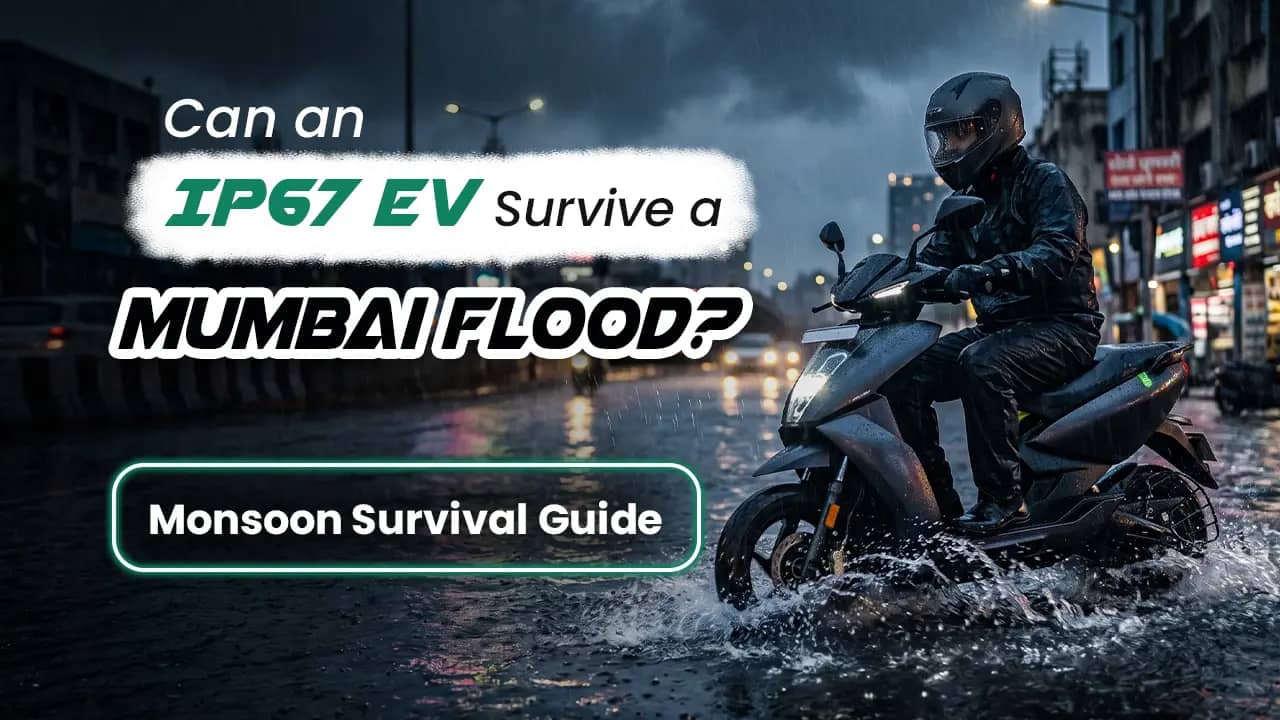
Electric Scooter Monsoon Survival Guide: Can an IP67 EV Survive a Mumbai Flood?
Overview
Electric Scooter Monsoon Survival Guide: Can an IP67 EV Survive a Mumbai Flood? brings key updates for two-wheeler buyers in India. Every IP67 electric scooter sold in India comes with a promise: that it can survive being submerged in up to one metre of still water for 30 minutes. In Mumbai,
Every IP67 electric scooter sold in India comes with a promise: that it can survive being submerged in up to one metre of still water for 30 minutes. In Mumbai, where June through September routinely turns arterial roads into chest-high channels, that claim isn't marketing copy — it's a question of whether you make it home. With the 2026 monsoon already battering the Konkan coast and top-rated EVs priced between ₹1.10 lakh and ₹1.55 lakh ex-showroom across India, riders need to know exactly what that IP67 badge means in practice, and more importantly, what it doesn't.
What IP67 Actually Means for Your Electric Scooter
The "IP" stands for Ingress Protection, a standard defined by the International Electrotechnical Commission. The first digit — 6 — confirms complete dust-tight sealing. The second digit — 7 — means the unit was tested against temporary immersion in up to 1 metre of water for 30 minutes under controlled laboratory conditions. What the rating does not cover is sustained flooding, flowing water under pressure, or repeated submersion cycles — all of which a single Mumbai commute in July can easily exceed.
Critically, IP67 protection on an electric scooter typically applies to the battery pack, motor, and primary ECU. The charging port flap, instrument cluster connectors, and under-seat wiring harness are often separately rated — or in some cases, not rated at all. When a dealer tells you "the scooter is IP67," ask which specific components carry that certification. The answer matters enormously when you're inching through knee-deep water on the Western Express Highway.
The Components That Actually Fail First
On hub-drive EVs like the Ather 450X Gen 3, Ola S1 Pro Gen 2, and TVS iQube S — India's three highest-volume electric scooters right now — the motor and battery casing are sealed to IP67 at the factory. But the 12V auxiliary circuit, lighting harness, and regen controller are housed in less protected areas. In real flooding scenarios, it's rarely the battery that fails first. It's a corroded connector behind the legshield or a waterlogged wiring loom near the headlamp cluster that triggers a fault code three weeks after the monsoon has ended and the warranty team has stopped looking.
Can the Ather 450X or Ola S1 Pro Survive a Mumbai Flood?
The Ather 450X Gen 3, priced at ₹1.55 lakh ex-showroom Mumbai (on-road approximately ₹1.72 lakh), and the Ola S1 Pro Gen 2 at ₹1.30 lakh ex-showroom both carry IP67 certification across their core electrical architecture. Ather has been the more transparent of the two — the brand has published wading test footage, and the 450X's aluminium battery casing is among the more robustly engineered units in the segment. Ola's claim covers the BMS and motor convincingly, but post-heavy-rain software errors reported by S1 Pro owners in Chennai and Pune suggest that water ingress into secondary systems remains a real-world concern that the spec sheet doesn't fully capture.
The TVS iQube S at approximately ₹1.27 lakh ex-showroom Delhi (on-road near ₹1.42 lakh) also holds IP67 certification and benefits from TVS's deep dealer network — a practical post-monsoon servicing advantage that urban riders consistently underestimate. The Bajaj Chetak Premium, retailing around
₹1.20 lakh ex-showroom, uses a pressed-steel body construction that resists panel flex and consequent seal degradation better than plastic-bodied rivals over multiple monsoon seasons. Drivio's TVS iQube buying guide and Bajaj Chetak review break down the on-road pricing across major cities if you're comparing both options.
Where the Real Danger Begins
IP67 testing is conducted in still, clean water. Mumbai's July floods carry debris, chemical runoff, and suspended particulates that degrade rubber seals over time. Most manufacturers unofficially recommend a practical wading limit of 200–250mm for electric scooters — roughly mid-shin depth on an average adult. When water reaches the footboard, you are at the threshold. When it climbs toward the legshield, you are past it.
The threat isn't immediate failure — the sealing genuinely works in the short term. The risk is latent corrosion that manifests as intermittent errors and throttle hesitations months later, long after the service advisor has attributed it to "normal wear."
How to Actually Ride an IP67 Electric Scooter Through Monsoon Season
The certification is a floor, not a ceiling. In May 2026, as pre-monsoon showers have already overwhelmed drainage in parts of Bengaluru and Hyderabad, the practical habits matter as much as the ingress rating. Keep the charging port sealed whenever the scooter isn't plugged in — the factory rubber flap degrades with seasonal use and should be replaced if it no longer clips flush. Avoid riding through stationary water above footboard level; moving through shallow water at a steady pace is significantly less damaging than sitting idle in deeper water, where pressure differentials can work moisture past seals.
After any significant flood exposure, park in a dry, ventilated space for at least 30 minutes before charging. On the Ola S1 Pro, using "Normal" mode rather than "Hyper" in wet conditions reduces motor heat cycling and puts less stress on gasket interfaces. On the Ather 450X, skip "Warp" mode entirely in heavy rain — not for electrical reasons, but because hard acceleration on waterlogged roads with compromised tyre contact is a faster way to end your commute badly.
After the Flood: The ₹500 Service Check That Saves ₹15,000
If your scooter has been submerged beyond ankle depth, do not plug it in immediately. Take it to an authorised service centre and request a connector inspection and compressed-air blow-down of the wiring harness. This procedure costs ₹300–₹800 at most dealerships and routinely prevents corrosion damage that runs to ₹12,000–₹18,000 six to nine months later. Ather and TVS service centres are generally well-equipped for this. Ola's network, while meaningfully improved through 2025–26, still has uneven technical depth in Tier-2 cities — factor that into your buying decision if you're outside Mumbai, Delhi, or Bengaluru.
The Verdict: IP67 Is Enough — With the Right Rider Behind It
A well-built IP67 electric scooter is entirely capable of surviving Indian monsoon conditions, including the episodic urban flooding that Mumbai, Chennai, and Hyderabad residents treat as seasonal background noise. The Ather 450X Gen 3 leads the segment for build integrity and post-monsoon resilience. The TVS iQube S offers the stronger value-plus-service equation for buyers who prioritise reliability over performance. The Ola S1 Pro delivers the best ride experience but demands a solid local service network to back it up. None of them are rated for sustained submersion — but ridden with awareness of that 200mm wading threshold, all three will get through the season intact.
Before the rains arrive in earnest, check the current on-road price and EMI options for the Ather 450X, TVS iQube S, or Bajaj Chetak in your city on Drivio — the gap between ex-showroom and on-road can reach ₹18,000, and knowing that number before you walk into the showroom changes the entire negotiation.
Every IP67 electric scooter sold in India comes with a promise: that it can survive being submerged in up to one metre of still water for 30 minutes. In Mumbai, where June through September routinely turns arterial roads into chest-high channels, that claim isn't marketing copy — it's a question of whether you make it home.