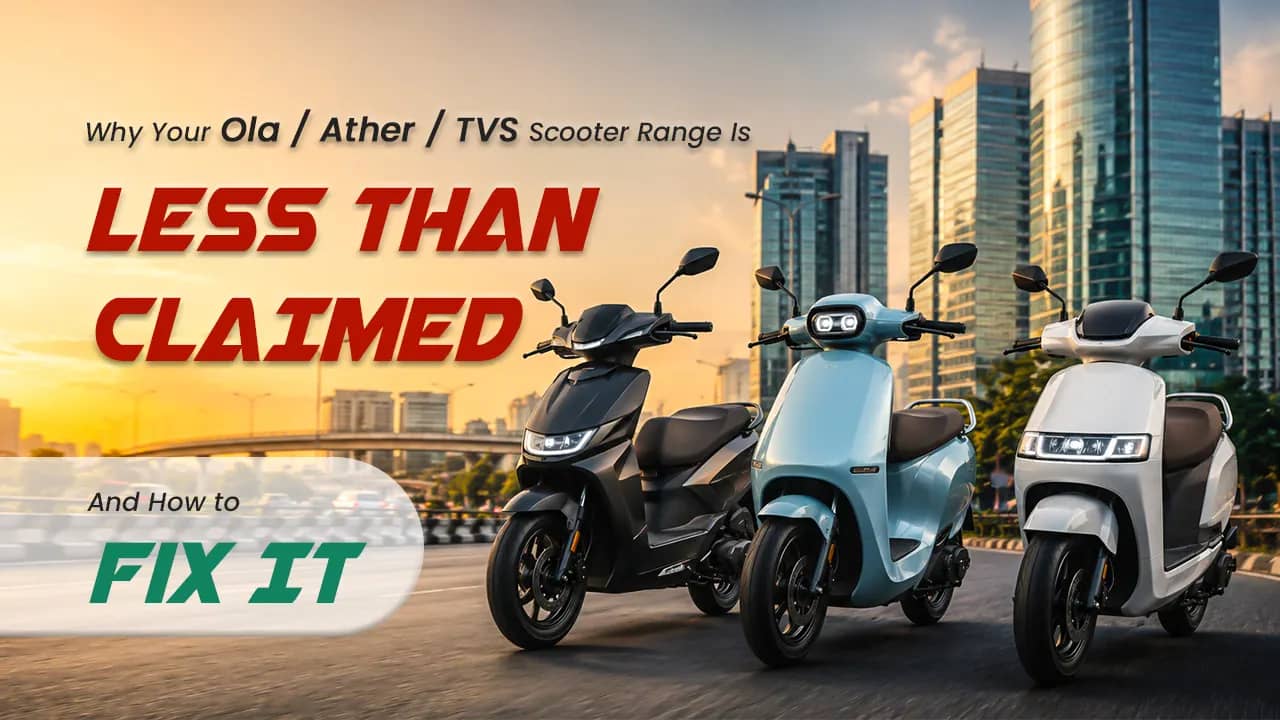
Why Your Ola / Ather / TVS Scooter Range Is Less Than Claimed — And How to Fix It
Overview
Why Your Ola / Ather / TVS Scooter Range Is Less Than Claimed — And How to Fix It covers Ola Electric's latest updates, featuring expanded color palettes, variant offerings, competitive pricing structures, and sales performance metrics across its electric scooter lineup.
Electric scooter range less than claimed is the single most searched complaint among EV owners in India right now — and in May 2026, with petrol sitting at roughly ₹103/litre and more riders switching to electric than ever before, the frustration is peaking. Ather claims 150 km on the 450X. Real-world riders in Bengaluru and Delhi are consistently getting 105–115 km. Ola S1 Pro owners report numbers running 25–30% below the stated IDC figure on their daily commute. This isn't a manufacturing defect. It's a gap between lab conditions and the road you actually ride on — and once you understand why it exists, you can close it significantly.
The IDC Number Was Never Meant for Your Morning Commute
The Indian Driving Cycle, or IDC, is a standardised test protocol where a scooter is ridden on a dynamometer — a stationary roller — at controlled speeds, fixed ambient temperatures, and zero real-world variables. No traffic lights. No flyovers. No 42-degree Delhi summer heat. No pillion.
The Ather 450X carries an IDC-tested range of 150 km. The Ola S1 Pro quotes 195 km in Eco mode under IDC. The TVS iQube ST lists 100 km. What these figures represent is the absolute best-case energy efficiency of the battery pack — not what happens when you're stuck in Gurgaon's NH-48 snarl at 8:15 AM with full luggage and Sport mode on.
Real-world range for the Ather 450X in typical Bengaluru city riding comes in around 105–120 km. The Ola S1 Pro, ridden normally across mixed urban conditions, delivers roughly 130–150 km in Eco — considerably less in Normal or Sport. The iQube ST is the most honest of the three, typically returning 75–90 km in real use, which is at least proportionally closer to its IDC claim.
The gap isn't unique to India, but our riding conditions make it worse than almost anywhere else.
What's Actually Draining Your Battery
Stop-go traffic is the real killer. Unlike petrol engines, electric motors are most efficient at steady, moderate speeds. Every time you accelerate hard from a standstill — at a signal, after a speed breaker, merging into traffic — you're drawing a large current spike from the battery. Do this forty times in a 15-km commute and the watt-hour consumption climbs steeply. Riders expecting IDC figures in Delhi traffic will be disappointed, every single time.
Sport mode is a range destroyer. On the Ather 450X, switching from Eco to Sport mode can cost you 20–35 km of range on a full charge. The throttle mapping becomes more aggressive, the motor responds faster, and current draw spikes with every input. It's useful for a quick overtake on an open road — using it as your default city setting is like driving a petrol car with the choke permanently open.
Speed above 70 km/h drains the pack dramatically. The battery percentage falls noticeably above 70 km/h on most Indian electric scooters, because aerodynamic drag increases exponentially with speed. The Ola S1 Pro and Ather 450X are both tested for range at speeds well below 60 km/h in IDC conditions. Sustained highway riding above 70–75 km/h on a flyover or expressway will cut your usable range by 20–30% compared to city riding.
Heat is a silent enemy. Lithium-ion batteries operate best between 15–35°C. In Delhi, Nagpur, or Hyderabad through April–June, ambient temperatures regularly cross 42°C, and a battery pack sitting in direct sun can exceed 45°C internally before you've even started. At these temperatures, internal resistance rises, capacity temporarily drops, and the battery management system (BMS) may begin throttling output to protect cell health. You might notice a 10–15 km reduction in estimated range just from a hot-parked scooter on a summer afternoon.
Fast charging, used repeatedly, has long-term consequences. DC fast charging pushes high current into the pack quickly, which generates heat and stresses cells. Occasional fast charging is fine — it's what the system is designed for. But riders who fast charge daily to 100% and then immediately ride are consistently putting thermal stress on their packs. Over time, this subtly degrades usable capacity.
Tyre pressure is underrated. A tyre running 3–4 PSI below the recommended pressure creates more rolling resistance against the road surface. On the Ola S1 Pro, this seemingly small oversight can reduce range by 7–10 km on a full charge. It's one of the easiest fixes available and one of the most ignored.
Pillion weight adds up fast. Carrying a pillion adds roughly 15–20% extra load on the motor. The Ather 450X is relatively light at 108 kg kerb weight — add an 80 kg rider and a 65 kg passenger and the motor is working significantly harder to maintain pace. This is physics, not a brand-specific issue.
How to Increase Electric Scooter Range in India
The good news: most of these losses are recoverable. Here's what actually moves the needle.
Ride in Eco mode for daily commuting. It sounds obvious but most buyers switch to Normal or Sport within a week of purchase and never go back. Eco mode on the Ather 450X and iQube ST limits top-end power draw and smooths throttle response — in stop-go city riding, it consistently adds 15–25 km of real range over Sport.
Smooth your throttle inputs. Gradual acceleration from signals, rather than twisting hard immediately, is the single highest-impact behaviour change. If you can avoid the battery current spike at each traffic light, your watt-hour consumption per kilometre drops noticeably. Experienced EV riders describe it as "sliding" away from a stop rather than launching.
Use regenerative braking properly. Most Indian scooters offer adjustable regen levels. Higher regen in stop-go traffic recovers energy that would otherwise be wasted as heat in the brake pads. On the Ather 450X, aggressive regen in Bengaluru's traffic conditions can recover 5–8% additional range compared to coasting. The key is anticipating slowdowns early and letting the regen do the work, rather than braking at the last moment.
Keep tyre pressure at the recommended spec. Check it monthly — 32–36 PSI front and rear depending on your scooter's spec sheet. It takes two minutes and can recover 7–10 km of range.
Charge to 80–90% for daily use, not 100%. Lithium-ion cells are under least stress between 20–80% state of charge. Charging to 100% every night and leaving it there accelerates long-term degradation. For your daily 30–40 km commute, 80% charge is sufficient and kinder to the pack. Reserve full charges for days you actually need the range.
Park in shade, especially in summer. A battery cooled to 30°C before riding starts at higher efficiency than one that sat in direct sun all day. In Indian summers, this alone can restore 8–12 km of effective range.
Keep software updated. Both Ola and Ather have pushed OTA updates that improved range estimation accuracy and battery management logic. Some early Ola S1 owners saw meaningful improvements in actual usable range after specific firmware updates. Ignoring update prompts means leaving potential improvements on the table.
Which Scooter Is Most Honest About Its Range?
If real-world accuracy is your priority, the TVS iQube ST comes closest to delivering what it claims — not because it has the best technology, but because TVS quoted a more conservative IDC figure to begin with. The gap between claimed and real is narrower, and the riding experience is predictable.
The Ather 450X is the best scooter for city commuting if you're a thoughtful rider — regenerative braking works well in dense traffic, the app-based range prediction is more mature than competitors, and Eco mode genuinely extends range usefully. The 105–120 km real-world figure is achievable consistently.
The Ola S1 Pro offers the largest battery and highest peak claimed range, but the gap between IDC figures and real-world results has been the most discussed among Indian owners. In Eco mode with smooth riding, 130–150 km is genuinely achievable — but riders used to motorcycles who ride with an aggressive throttle hand will be consistently disappointed.
None of these scooters are badly engineered. They're simply tested under conditions that don't reflect a Gurgaon or Bengaluru commute. Once you internalise that, the ownership experience becomes significantly less frustrating.
Verdict: Electric scooter range is manageable, not mythical. The 30–40% gap between IDC claims and real-world results shrinks to 15–20% once you understand how to ride and charge properly. At petrol sitting at roughly ₹103/litre, the running cost advantage of electric still holds firmly even at reduced real-world range — a 100 km ride on an Ather costs a fraction of what the same distance costs on a 125cc petrol scooter. The technology is sound. The adjustment is in expectations and habits. Before you make your decision, check the on-road price and EMI options for the Ola S1 Pro, Ather 450X, or TVS iQube in your city on Drivio.
Electric scooter range less than claimed is the single most searched complaint among EV owners in India right now — and in May 2026, with petrol sitting at roughly ₹103/litre and more riders switching to electric than ever before, the frustration is peaking. Ather claims 150 km on the 450X. Real-world riders in Bengaluru and Delhi are consistently getting 105–115 km.