Hybrid Two-Wheelers Are Coming to India — And the Pure EV Scooter Has a Real Fight on Its Hands
Overview
Hybrid Two-Wheelers Are Coming to India — And the Pure EV Scooter Has a Real Fight on Its Hands brings key updates for two-wheeler buyers in India. Hybrid two-wheelers are no longer a concept reserved for Japanese domestic brochures — they are heading to India, with Honda and Hero MotoCorp both believed to be preparing mild-hybrid and
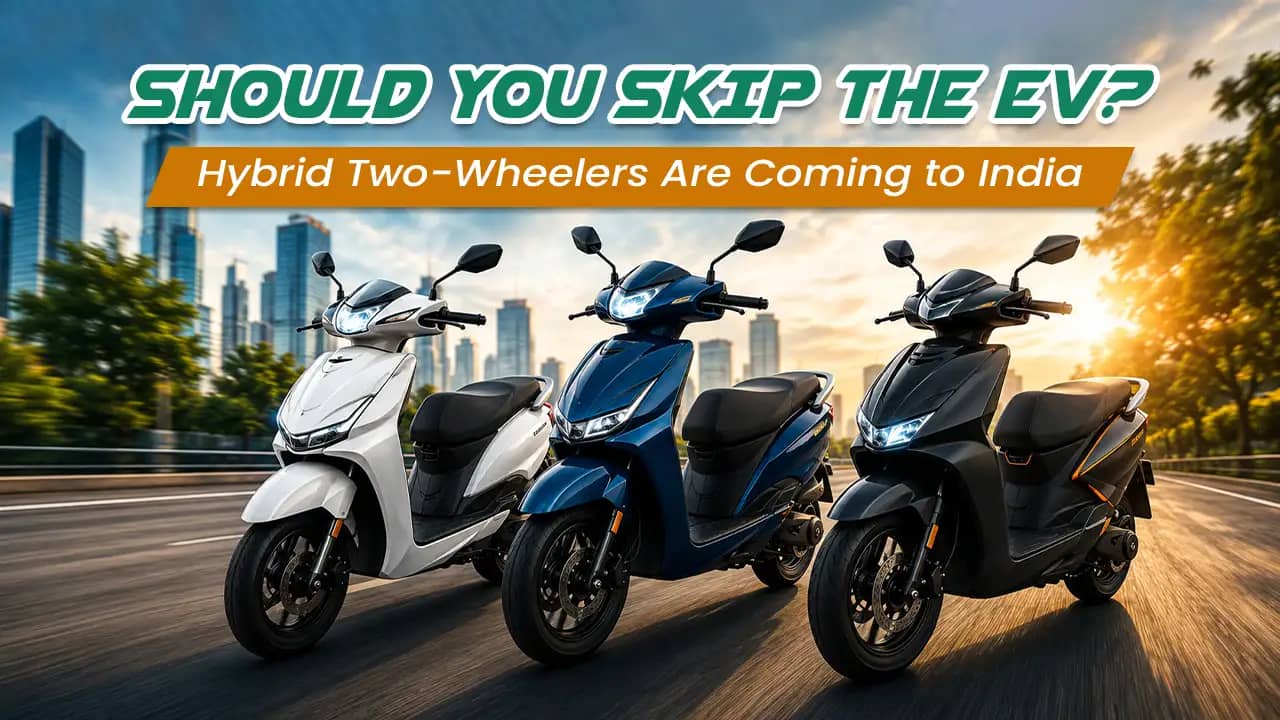
Hybrid two-wheelers are no longer a concept reserved for Japanese domestic brochures — they are heading to India, with Honda and Hero MotoCorp both believed to be preparing mild-hybrid and full-hybrid scooter platforms for the ₹1.20–1.70 lakh segment by late 2026. That puts them squarely in the price bracket where the electric scooter war has been most brutal, and it raises a question that every urban commuter considering a new scooter in India should be asking right now: is a petrol-electric hybrid a smarter buy than a pure EV?
Why the Timing Is No Accident
The answer has a lot to do with what pure EVs have failed to solve in three years of aggressive pushing. Range anxiety remains real. Public charging infrastructure outside metro cities is patchy at best. And the realities of Indian apartment living — no dedicated parking, no access to a wall socket — mean that a large chunk of potential EV buyers simply can't make the ownership equation work. In May 2026, the electric scooter segment is growing, but it is growing slower than the projections suggested it would. Hybrid two-wheelers walk straight into that gap.
Honda's approach elsewhere in Asia is the clearest signal of what's coming. The PCX Hybrid, sold in Japan and Thailand, pairs a 125cc internal combustion engine with a compact lithium-ion battery and an ACG starter-motor that functions as a mild-hybrid assist unit. It doesn't run on electricity alone — you still fill petrol — but it recovers braking energy and uses it to cut fuel consumption and sharpen low-speed response. Real-world fuel economy in urban riding comes out around 50–55 kmpl, which in India, at petrol prices hovering near ₹103 per litre, translates to a monthly fuel bill roughly 20–25 percent lower than a conventional 125cc scooter. That is a number commuters will notice.
The Mild Hybrid vs Full Hybrid Question
Not all hybrid two-wheelers are built the same, and understanding the difference matters before you decide. A mild hybrid — the type Hero MotoCorp has been developing under its 'iSmart' evolution and what Honda's smaller platform likely uses — cannot propel the scooter on electricity alone. The electric motor assists the petrol engine during acceleration and at traffic stops, reducing the load on the engine. A full or parallel hybrid, which Honda has demonstrated in larger displacement formats, can move the vehicle short distances on electric power only. For stop-start Mumbai or Delhi traffic, a full hybrid makes more sense. For National Highway runs, a mild hybrid is more than sufficient.
Either way, both eliminate the single biggest deterrent to mass EV adoption: the need to charge. You fill up at any petrol pump in the country. The range question disappears entirely. And for the 60–70 percent of Indian scooter buyers who cover between 25 and 50 kilometres a day across mixed terrain, that reliability matters more than zero-emission bragging rights.
How They Stack Up Against the Best Pure EVs Right Now
The Ather 450X — currently priced at approximately ₹1.50 lakh ex-showroom — is the benchmark for what a performance-oriented electric scooter can be in India. It delivers 6.4 kW peak power, does 0-40 kmph in under 3.3 seconds, and has a genuine real-world range of around 100–110 kilometres in mixed city riding. The TVS iQube ST, at ₹1.27 lakh, is slightly more conservative but better suited to pure commuting, with a ARAI-claimed range of 145 km that translates to roughly 100–115 km in actual Bengaluru or Hyderabad traffic. Both are excellent products. Both still need you to charge them.
Drivio has covered the Ather 450X and the TVS iQube ST in detail — and the consistent thread across long-term ownership stories is that the charging discipline required is the biggest lifestyle adjustment. Not difficult, but present. An incoming hybrid two-wheeler removes that adjustment completely. You ride it exactly like you'd ride an Activa — stop at a pump, two minutes, move on.
What Indian Roads Actually Demand
The hybrid advantage compounds on Indian roads specifically. Our urban riding profile is genuinely ideal for energy recovery: dense stop-start traffic, frequent braking, low average speeds. A regenerative braking system on a hybrid scooter in peak-hour Connaught Place or Lower Parel traffic is constantly topping up the battery. The same profile that stresses a lithium pack through repeated deep discharge cycles in an EV actually works in favour of a hybrid architecture. Add to that the heat — battery performance degrades in the 40°C+ summer conditions that most of north and central India sees from April to June — and a hybrid's smaller, less thermally stressed battery pack looks like a longer-term reliability bet.
The on-road price for an expected Honda hybrid scooter in Delhi will likely land between ₹1.45 and ₹1.65 lakh once registration, insurance, and road tax are factored in. That sits above the Honda Activa e: but below a loaded Ather 450X on-road — a positioning that makes competitive sense.
Will Hybrids Kill the Pure EV Scooter?
Probably not kill — but they will absolutely complicate the buying decision, and they will do the most damage to the mid-range EV segment around the ₹1.10–1.40 lakh mark. The premium pure EVs — Ather, Ola S1 Pro, the upcoming Bajaj Chetak variants — sell as much on brand aspiration and tech features as on the green argument. Buyers in that bracket will still find reasons to stay electric. But the mass-market commuter who was never fully convinced by range claims and charging logistics? Hybrid two-wheelers are built for exactly that person.
The verdict for now: if you're buying today and you live in a metro with reliable home charging, the TVS iQube ST or Ather 450X remain strong choices. If you're in a tier-2 city, cover variable distances, or simply don't want to think about plugging in, it's worth waiting until the hybrid scooter launches clarify in the second half of 2026. Either way, check the current on-road price and EMI options for the scooter you're considering in your city on Drivio before you commit.
Hybrid two-wheelers are no longer a concept reserved for Japanese domestic brochures — they are heading to India, with Honda and Hero MotoCorp both believed to be preparing mild-hybrid and full-hybrid scooter platforms for the ₹1.20–1.70 lakh segment by late 2026.